




 By
By By Elizabeth Ugbo
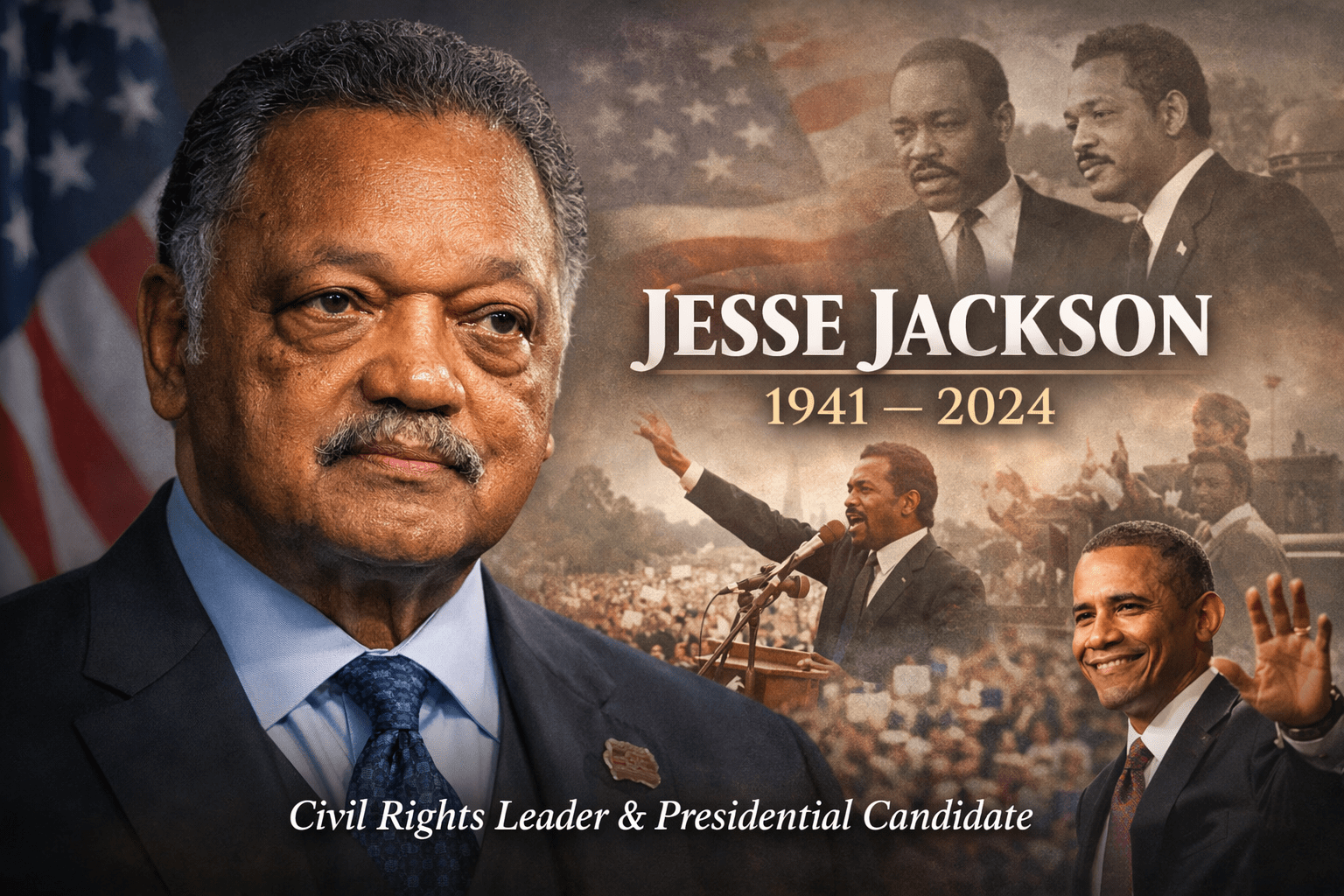
The Rev. Jesse Louis Jackson, a towering American civil rights leader and two-time presidential candidate, died on Tuesday morning at age 84, his family announced. He died surrounded by relatives after months of hospitalization for progressive supranuclear palsy, according to his organization, Rainbow PUSH Coalition.
Jesse Jackson Dies at 84 After Long Illness
Jackson had battled serious health challenges in recent years. Doctors had earlier diagnosed him with Parkinson’s disease before confirming progressive supranuclear palsy.
Despite his illness, he remained a powerful symbol of hope and justice. His family described him as a tireless advocate for equality and human rights.
From Protégé of Martin Luther King Jr. to National Leader
Jackson rose to national prominence in the 1960s as a close aide to Martin Luther King Jr.. After King’s assassination in 1968, he stepped forward as a leading voice in the civil rights movement.
Although some of King’s aides criticized his bold style, Jackson expanded the movement’s reach. He later founded the Rainbow PUSH Coalition to promote economic empowerment and social justice.
Historic Presidential Campaigns That Reshaped the Democratic Party
In 1984 and 1988, Jackson launched groundbreaking campaigns for the Democratic presidential nomination. At the time, many doubted a Black candidate could compete nationally. However, he proved them wrong.
His campaigns energized Black voters and attracted White supporters. More importantly, he pushed the Democratic Party toward a multicultural coalition.
He also fought to reform delegate allocation rules. Instead of winner-take-all systems, he supported proportional representation. As a result, future candidates benefited, including Barack Obama during the 2008 primaries.
Political analysts argue that Jackson’s campaigns laid the foundation for Obama’s historic victory.
Champion of the “Rainbow Coalition”
Jackson promoted unity through his Rainbow Coalition. He built alliances among Black, White, Latino, Asian American, Native American, and LGBTQ communities.
“Our nation is a rainbow,” he often said. He consistently urged Americans to “Keep hope alive.”
Furthermore, he became the first major presidential candidate to openly support gay rights in his platform. Consequently, he broadened the Democratic Party’s priorities beyond traditional voter blocs.
Early Life Shaped His Drive
Jackson was born on October 8, 1941, in Greenville, South Carolina, during the Jim Crow era. His mother, Helen Burns, was a teenage parent. His biological father was a married neighbor, Noah Robinson. Later, Charles Jackson adopted him.
As a child, classmates teased him about his birth. Nevertheless, he transformed personal pain into ambition. He often declared, “I Am Somebody,” reinforcing dignity and self-worth.
In 1962, he married Jacqueline Lavinia Brown. Together, they raised five children and endured decades of public scrutiny.
Controversies and Global Diplomacy
Like many public figures, Jackson faced controversies. Critics accused him of exaggerating certain events and making offensive remarks. He also acknowledged personal mistakes.
Yet he continued to influence global affairs. In 1984, he negotiated the release of American prisoners in Cuba. Later, he helped secure the freedom of U.S. soldiers held in Yugoslavia.
In 2000, he received the Presidential Medal of Freedom for his service.
Health Challenges and Final Years
Jackson experienced several health setbacks in his later years. In 2021, he and his wife tested positive for COVID-19. He also suffered injuries after a fall during a protest.
Still, he remained active in voting rights and criminal justice reform campaigns. In 2023, he stepped down as president of the Rainbow PUSH Coalition after more than five decades of leadership.
In 2024, the Democratic National Convention honored him as a civil rights pioneer. He witnessed the rise of leaders like Kamala Harris, whose nomination reflected the inclusive vision he championed.
A Lasting Legacy of Hope
Jackson bridged three eras: Jim Crow, the civil rights movement, and modern America. He reshaped national politics through faith, activism, and fearless speech.
When Obama won the presidency in 2008, cameras captured Jackson in tears. He later explained that he remembered those who sacrificed for change.
Jesse Jackson leaves behind his wife Jacqueline, six children, and millions inspired by his message.
Above all, he ensured that hope remained alive in American politics.