




 By
By By Elizabeth Ugbo
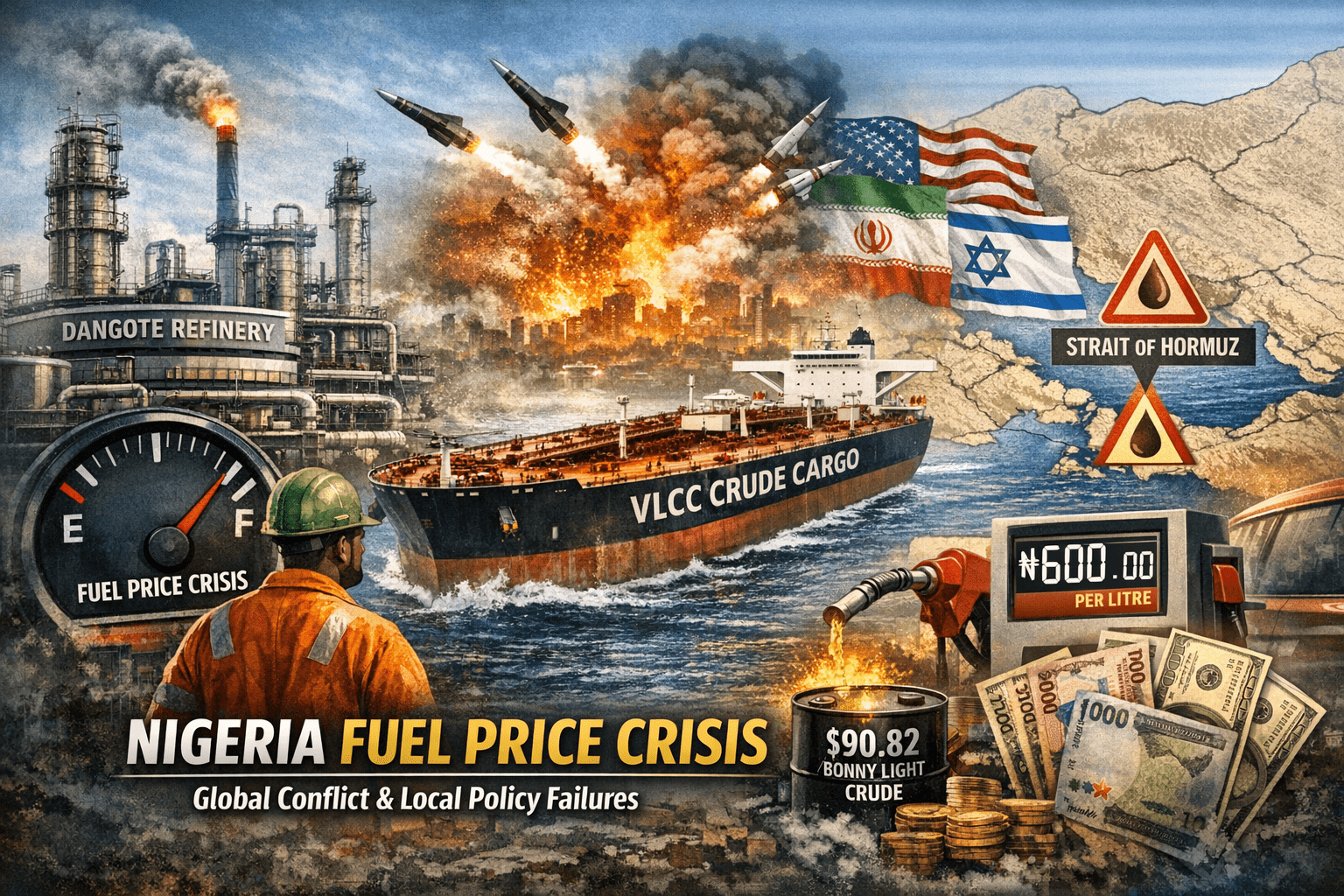
Nigeria faces a worsening fuel price crisis driven by global conflict and domestic policy failures. The crisis affects petrol prices across the country. It involves Nigeria’s struggling refinery system, the operations of the Dangote Refinery, and rising crude prices triggered by war involving Donald Trump, Benjamin Netanyahu, and Mojtaba Khamenei. The situation worsened after reported attacks that killed Ali Khamenei and pushed oil markets upward. Consequently, petrol prices in Nigeria have increased by ₦450 to ₦600 per litre.
Nigeria’s Refinery Problem: A Costly National Failure
Nigeria currently operates without functional government refineries. Authorities previously claimed that the Port Harcourt and Warri refineries had resumed operations. However, those claims proved false.
The temporary restart reportedly cost the country about $7.5 billion. Yet the facilities still failed to refine crude sustainably. Meanwhile, workers remain employed in refineries that have not processed crude for years.
This situation weakens Nigeria’s energy security and increases dependence on imported refined products.
Dangote Refinery: A Potential Game Changer Facing Obstacles
Many Nigerians welcomed the private investment that produced the massive Dangote Refinery. The refinery has a 650,000-barrel-per-day capacity and could transform Nigeria’s fuel supply.
However, several challenges slowed its operations. Initially, critics alleged the refinery produced substandard fuel. Later, the refinery struggled to obtain local crude supplies.
Eventually, presidential intervention ensured some crude allocation. Even so, the refinery still receives only five of the twelve crude cargoes it requires locally.
Therefore, the refinery imports the remaining cargoes from international markets.
Understanding Crude Cargo Supply
Crude oil moves across the world using specialized tankers. These vessels carry different volumes of crude depending on their size.
For example:
- Ultra Large Crude Carriers (ULCCs) transport over three million barrels.
- Very Large Crude Carriers (VLCCs) carry more than two million barrels.
- Suezmax tankers transport about one million barrels.
- Aframax vessels carry between 600,000 and 800,000 barrels.
Because local supply remains insufficient, the refinery must import several cargoes. Consequently, global market conditions directly influence Nigeria’s domestic fuel prices.
Naira Pricing and the Cost of Local Crude
Nigeria sells crude to local refiners in naira but at dollar-based prices. As a result, local refiners still face international price pressures.
Currently, Nigeria’s Bonny Light crude trades around $90.82 per barrel globally. When the naira weakens, the cost of crude increases for domestic refiners.
Therefore, fuel prices remain unstable despite local refining capacity.
The 445,000 Barrels Policy and Its Economic Impact
Government policy allocates 445,000 barrels of crude daily for domestic refining. In practice, authorities sold much of this crude in international markets.
Officials then used the revenue to import refined fuel.
Meanwhile, Nigeria continues to pay salaries to employees of four state-owned refineries that remain largely inactive. This policy places additional strain on national finances.
Middle East Conflict and Global Oil Prices
Global conflict now intensifies the crisis. Military strikes by the United States and Israel against Iran have pushed oil prices upward.
This conflict also threatens shipping through the Strait of Hormuz. The waterway carries about 20% of global crude shipments.
Because of the risks, shipping companies now divert vessels to longer routes. As a result, transportation costs and insurance premiums have increased sharply.
Why Distant Wars Affect Nigeria
Nigeria sits thousands of kilometres away from the conflict zone.
- Abuja lies about 5,352 km from Tehran by air.
- Lagos lies about 5,861 km away by air.
Despite the distance, global oil markets connect economies closely. Therefore, conflicts abroad quickly affect Nigeria’s fuel prices and daily living costs.
The Urgent Need for Energy Reform
Nigeria must urgently reform its energy policies. First, the country needs functional refineries. Second, policymakers should consider price incentives for local refiners.
Lower crude prices for domestic refining could stabilize fuel supply. Moreover, stronger energy planning would protect Nigerians from global shocks.
Until these reforms occur, international conflicts and currency volatility will continue to drive Nigeria’s petrol prices upward.