



 By
By By Elizabeth Ugbo
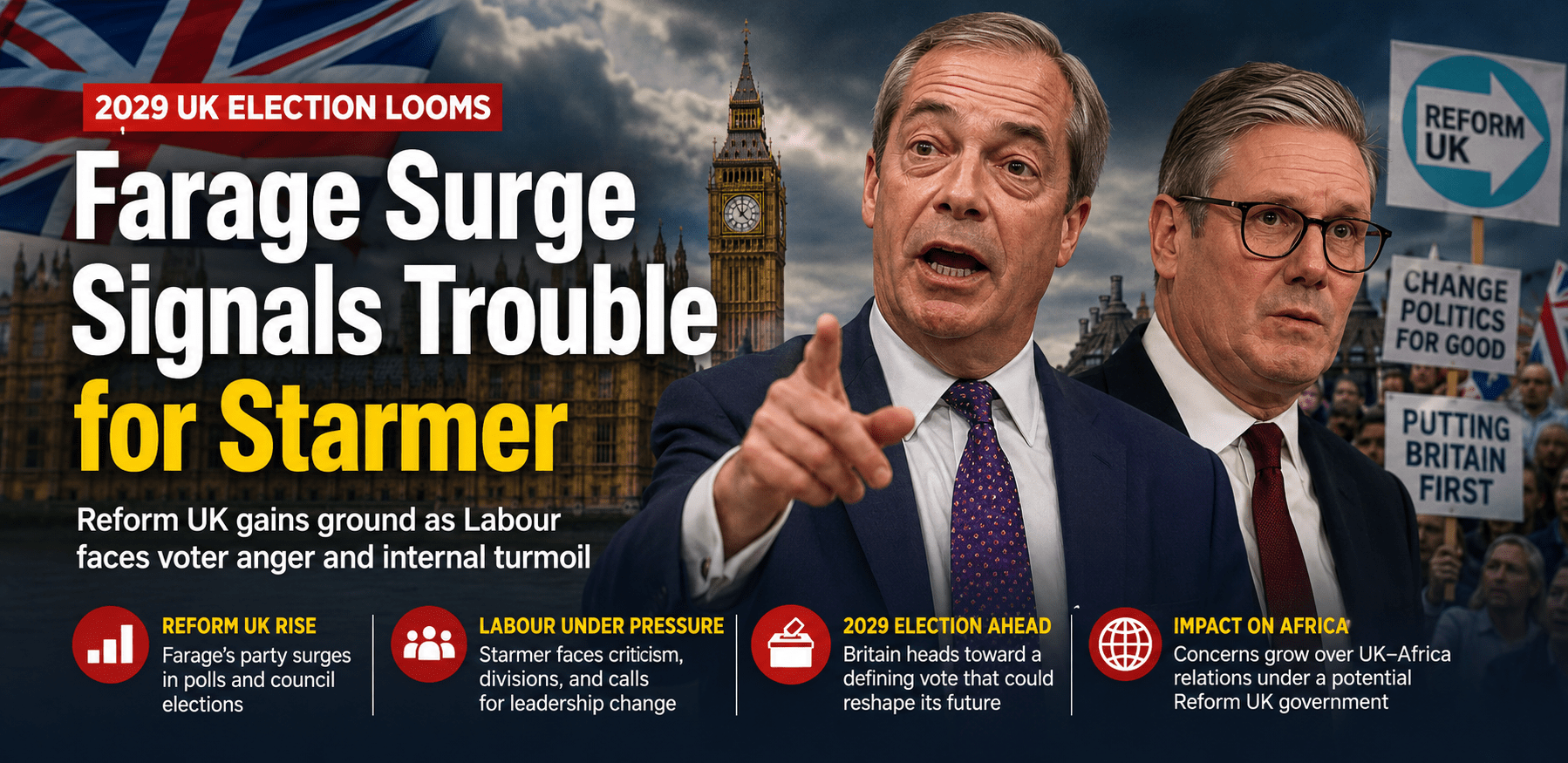
The May 7 council elections in Britain exposed deep cracks within Prime Minister Keir Starmer’s Labour government. Nigel Farage’s Reform UK Party gained momentum by targeting frustrated voters across England. The surge happened because many Britons feel ignored on immigration, identity, and economic hardship. Political analysts now question how long Starmer can remain in power before the 2029 general election.
Labour’s Historic Victory Has Quickly Lost Momentum
Only two years ago, Labour secured a landslide victory after 14 years of Conservative rule. Voters punished the Conservatives for Brexit turmoil, inflation, leadership scandals, and pressure on the NHS.
However, Labour’s victory masked deeper weaknesses. The party won many parliamentary seats but secured a smaller share of the national vote. Therefore, the result reflected voter frustration with Conservatives more than enthusiasm for Labour.
Today, Labour faces internal division, declining influence, and growing dissatisfaction among working-class voters.
Reform UK Exploits Voter Anger
Nigel Farage’s Reform UK Party filled the political vacuum quickly. The party focused heavily on immigration, national identity, distrust of elites, and economic frustration.
As a result, Reform UK attracted voters who once supported Labour and the Conservatives. Smaller parties like the Greens and Liberal Democrats also benefited from growing dissatisfaction with Britain’s traditional two-party system.
Moreover, Labour has lost influence in several traditional “Red Wall” councils. These losses intensified calls for leadership changes inside the ruling party.
Why Farage’s Message Resonates With Many Voters
According to Bola Adediran, a Nigerian-born Conservative Party candidate in Bromley, Farage connects strongly with frustrated voters.
Adediran explained that Farage appeals to people worried about immigration, identity politics, and economic uncertainty. He added that Farage positions himself as the voice of citizens ignored by mainstream politicians.
Still, critics argue that Farage exploits economic grievances for political advantage. Many also fear his populist rhetoric could deepen racial and social tensions.
Concerns Over Farage’s Political History
Farage remains a deeply controversial figure in British politics. Former classmates and teachers once accused him of making racist and antisemitic remarks during his school years.
Reports also claimed he praised Adolf Hitler and mocked immigrants and ethnic minorities. Farage denied all allegations.
Additionally, a 1981 letter from one of his teachers reportedly warned school authorities about his alleged “racist and neo-fascist views.”
Reform UK’s Position on Reparations Sparks Backlash
In April, Reform UK home affairs spokesperson Zia Yusuf announced a controversial proposal. He said a Reform government would stop issuing visas to citizens from countries demanding slavery reparations from Britain.
Yusuf specifically mentioned Nigeria, Ghana, Jamaica, Kenya, and Barbados.
The United Nations describes slavery as “the gravest crime against humanity” and supports reparations for affected communities. However, some critics oppose reparations because they believe the issue could fuel grievance politics.
Could Farage Become Britain’s Next Prime Minister?
Farage’s path to Number 10 remains uncertain but increasingly possible. Britain’s electoral system still disadvantages smaller parties like Reform UK.
Historically, Farage’s previous parties, including UKIP and the Brexit Party, struggled to convert votes into parliamentary seats.
Nevertheless, Reform UK continues gaining attention in polls and headlines. Meanwhile, Labour struggles to produce strong alternative leaders.
Political observers mention Angela Rayner and Wes Streeting as possible successors to Starmer. However, neither currently commands overwhelming national support.
Manchester Mayor Andy Burnham may have emerged as a stronger challenger. Yet Starmer reportedly prevented his return to Parliament earlier this year.
Pressure Mounts on Starmer
Keir Starmer appears determined to stay in office despite mounting criticism. His appointment of Peter Mandelson as British ambassador to the United States triggered strong backlash but failed to force his resignation.
Still, dissatisfaction within Labour continues to grow. Many expect rebellion inside the party to intensify before the next election.
Consequently, analysts doubt Starmer will remain leader until 2029.
Can Britain’s Institutions Stop Populism?
Some political observers believe Britain’s institutions could restrain a Trump-style leader. They point to Parliament, the judiciary, and the House of Lords as important safeguards.
However, history shows democracies can still produce dangerous leaders. Countries like Hungary, Venezuela, Russia, and even Germany experienced democratic decline despite institutional protections.
Critics also cite former British Prime Minister Tony Blair and former US President George W. Bush. Both leaders supported the Iraq invasion based on claims about weapons of mass destruction that later proved false.
Therefore, institutional safeguards alone may not prevent political manipulation.
What Farage’s Rise Could Mean for Africa
Many Africans worry that stronger Reform UK influence could damage Britain’s relationship with Africa.
Farage’s immigration policies and comments on reparations have already raised concerns across several African nations.
Moreover, critics fear immigrants could become permanent scapegoats during economic hardship.
History repeatedly shows that blaming foreigners rarely solves economic crises. Instead, it often deepens division and social unrest.
Britain Faces a Defining Political Moment
Britain now stands at a critical political crossroads. Economic hardship, voter frustration, and distrust of elites continue reshaping the political landscape.
The decisions political parties make before 2029 could determine Britain’s democratic future and its relationship with Africa and the wider world.
If voters embrace populist demagoguery as the solution to economic hardship, Britain could face deeper political instability in the years ahead.