




 By
By By Elizabeth Ugbo
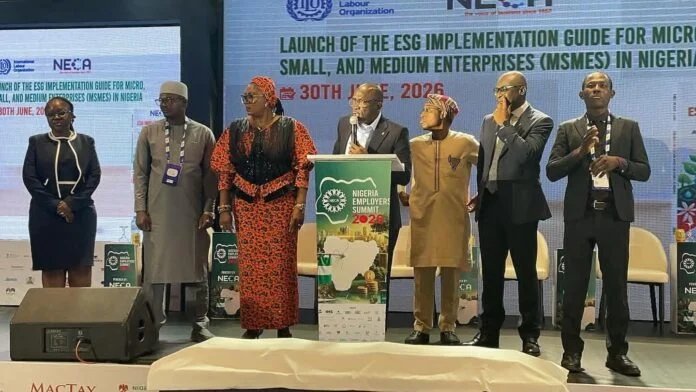
The Nigeria Employers’ Consultative Association (NECA) on Tuesday launched Africa’s first Environmental, Social and Governance (ESG) Implementation Guide for Micro, Small and Medium Enterprises (MSMEs) during the 2026 Nigeria Employers’ Summit in Abuja. The guide aims to help Nigerian small businesses adopt sustainability standards, improve competitiveness, access global finance, and prepare for mandatory ESG reporting expected by 2030.
MSMEs need practical ESG roadmap
Chairman of the NECA ESG Advisory Board, Femi Jaiyeola, described the guide as a milestone for Nigeria’s private sector.
He said MSMEs remain the backbone of the economy and require practical tools to compete in a rapidly changing global marketplace.
“I think we have a milestone event today. We all acknowledge that Micro, Small and Medium Enterprises play a significant role in Nigeria’s economy. They constitute a large proportion of what drives our economy on a daily basis.
“We also recognise the growing importance of Environmental, Social and Governance principles globally and in Nigeria. ESG has gone beyond being a mere tick-box exercise to satisfy regulatory requirements. It now presents enormous opportunities for MSMEs and for the country as a whole,” Jaiyeola said.
Mandatory ESG reporting expected by 2030
Jaiyeola noted that regulators, financial institutions, and international investors now demand stronger sustainability compliance from businesses of every size.
He therefore urged MSMEs to begin preparing immediately.
“The message for MSMEs is very clear. By 2030, ESG reporting is expected to become mandatory in Nigeria. Therefore, the time to prepare is now,” he said.
According to him, the implementation guide offers a practical roadmap that enables businesses to adopt ESG principles gradually while creating measurable business value.
“This guide has been developed as a practical, step-by-step roadmap to help MSMEs begin and grow their ESG journey in a simple and progressive manner while delivering real business value,” he added.
ESG offers more than regulatory compliance
Jaiyeola stressed that ESG adoption extends beyond compliance.
He explained that businesses embracing sustainability could gain easier access to finance, attract investors, strengthen market competitiveness, and improve long-term resilience.
“Beyond compliance with regulations, ESG provides tremendous opportunities. It enables MSMEs to access finance, strengthen competitiveness, enhance their reputation, and build long-term resilience and value,” he said.
He added that the guide would serve as a growth tool for Nigerian entrepreneurs.
“For me and my colleagues on the NECA ESG Advisory Board, this guide is more than a document. It is a practical tool that will help Nigerian MSMEs compete, grow and thrive in a sustainability-driven economy,” Jaiyeola stated.
NECA to train MSMEs across Nigeria
Jaiyeola disclosed that NECA developed the guide after conducting a national ESG assessment with support from the International Labour Organisation (ILO). The assessment was launched in December 2025.
He said the findings highlighted the urgent need to integrate MSMEs into Nigeria’s sustainability framework because of their contribution to employment and economic growth.
“What we are launching today is, to the best of our knowledge, the first ESG Implementation Guide specifically designed for MSMEs in Nigeria and across Africa,” he said.
Furthermore, he revealed that six NECA officials are undergoing specialised ESG training at the ILO International Training Centre in Turin, Italy.
After completing the programme, the officials will train MSMEs across Nigeria’s six geopolitical zones.
NECA seeks stronger government-business collaboration
Meanwhile, NECA Director-General Adewale Smart Oyerinde called for deeper collaboration between government and organised businesses to ensure the success of ongoing economic reforms.
He said reforms affect businesses, workers, and households alike. Therefore, private sector participation remains essential.
“Somehow, those reforms affect everybody: businesses, individuals, workers. So, for the reform to be effective, government needs the collaboration and support of organised businesses to drive it effectively,” Oyerinde said.
He added that NECA would present the summit’s communiqué to the Federal Government and other stakeholders.
“The outcome of this two-day summit in the form of the communiqué will be shared with the Honourable Minister and all other stakeholders. Our recommendations are not frivolous; they are not antagonistic, but they show alternative pathways to achieving Nigeria’s economic objectives,” he added.
Summit backs economic reforms
The two-day Nigeria Employers’ Summit ended on Tuesday with participants acknowledging that the Federal Government’s economic reforms were necessary to stabilise the economy and correct structural distortions.
However, delegates urged the government to deepen implementation while ensuring the benefits reach businesses and citizens more effectively.
The communiqué also recommended stronger policy coordination, closer collaboration with the organised private sector, and targeted measures to reduce the impact of reforms on businesses and households.
Why the ESG guide matters
Globally, ESG compliance increasingly determines access to international capital, export markets, and global supply chains.
Across Africa, MSMEs account for more than 90 per cent of businesses and create millions of jobs. However, many still lack structured sustainability frameworks.
In Nigeria, policymakers and business leaders have repeatedly warned that companies risk exclusion from global value chains if they fail to meet ESG standards, carbon disclosure requirements, and social governance expectations.
Consequently, NECA’s ESG Implementation Guide positions Nigerian MSMEs to remain competitive while preparing for future regulatory requirements.