



 By
By By Elizabeth Ugbo
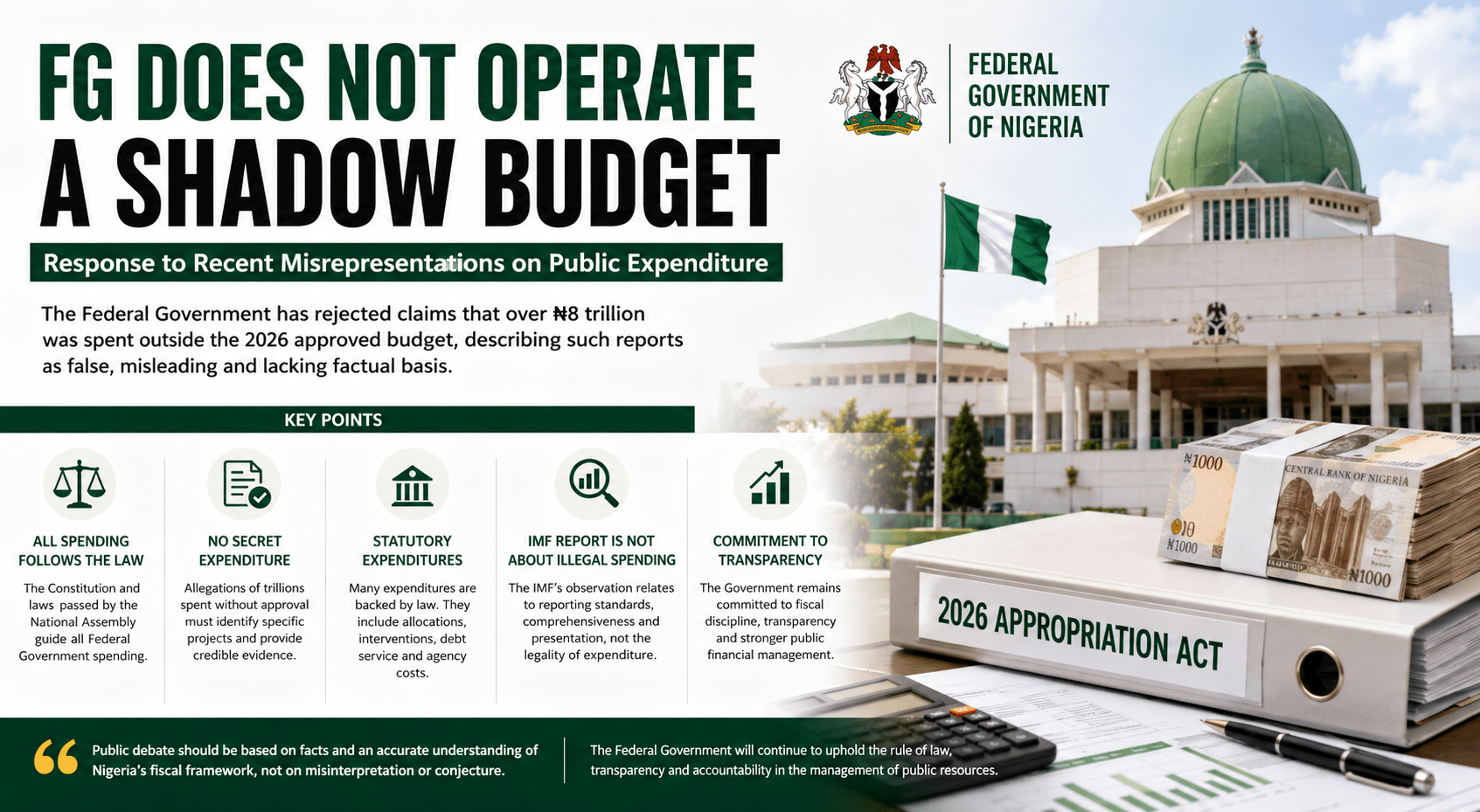
The Federal Government has dismissed claims that it spent more than ₦8 trillion outside the 2026 approved budget. The government issued the clarification in response to public commentary linked to the IMF’s 2026 Article IV Consultation Report. According to the government, the allegations misrepresent Nigeria’s public finance system. It stressed that all federal spending follows constitutional provisions and laws approved by the National Assembly. The statement aims to reassure Nigerians that no “shadow budget” exists.
FG Rejects Claims of Secret Public Spending
The Federal Government said reports alleging it operates a shadow budget are false and misleading.
According to the statement, every withdrawal and expenditure of public funds complies with Sections 80 to 83 and 162 of the 1999 Constitution (as amended). The government explained that spending only occurs through Appropriation Acts, Supplementary Appropriation Acts, or other laws passed by the National Assembly.
It also noted that some capital projects span several years. Therefore, approved capital rollovers remain a normal part of public financial management and should not be mistaken for unauthorized spending.
Government Demands Evidence for Allegations
The government challenged those making the allegations to provide evidence.
It argued that claims of trillions of naira spent without legislative approval should identify specific projects and demonstrate how they violated the law.
According to the statement, broad accusations without verifiable facts only mislead the public and weaken informed discussions on fiscal management.
Why Some Government Expenditure Appears Outside the Annual Budget
The Federal Government explained that Nigeria’s fiscal framework includes several expenditures created by law but presented differently in financial reports.
These include:
- Statutory allocations to development commissions and government agencies.
- Cost of collection retained by authorized revenue agencies.
- Capital expenditure approved separately for some agencies and the Federal Capital Territory.
- Special interventions for security, infrastructure, disasters, and national emergencies.
- Debt servicing and other statutory transfers authorized by law.
The government emphasized that these expenditures are legal, transparent, and subject to oversight and auditing.
IMF Report Focuses on Fiscal Reporting, Not Illegal Spending
The Federal Government clarified that the IMF’s 2026 Article IV Consultation Report discusses improvements in fiscal reporting rather than illegal expenditure.
According to the statement, the IMF’s observations relate to the comprehensiveness, timing, and presentation of government financial reports.
The government added that many countries continue to align their budget reporting with international standards, and Nigeria remains committed to that process.
Tinubu Previously Called for a Unified Budget Framework
The statement recalled that President Bola Ahmed Tinubu had already proposed ending the practice of multiple overlapping budgets.
During the presentation of the 2026 Appropriation Bill on December 19, 2025, the President asked the National Assembly to harmonize government budgets into a single framework.
The government said this reform demonstrates its commitment to improving transparency and accountability.
FG Reaffirms Commitment to Fiscal Transparency
The Federal Government said it remains committed to prudent fiscal management and responsible spending.
It highlighted recent reforms, including improved budget credibility, transparent revenue administration, digital financial processes, and stronger treasury management.
According to the statement, the IMF, international credit rating agencies, development partners, investors, and major global media organizations have acknowledged these reforms.
The government also encouraged public debate on fiscal matters. However, it urged citizens and stakeholders to rely on verified facts instead of misinterpreting technical reports.
It reaffirmed its commitment to working with the National Assembly, oversight institutions, development partners, and Nigerians to strengthen fiscal governance in line with international best practices.