



 By
By By Elizabeth Ugbo
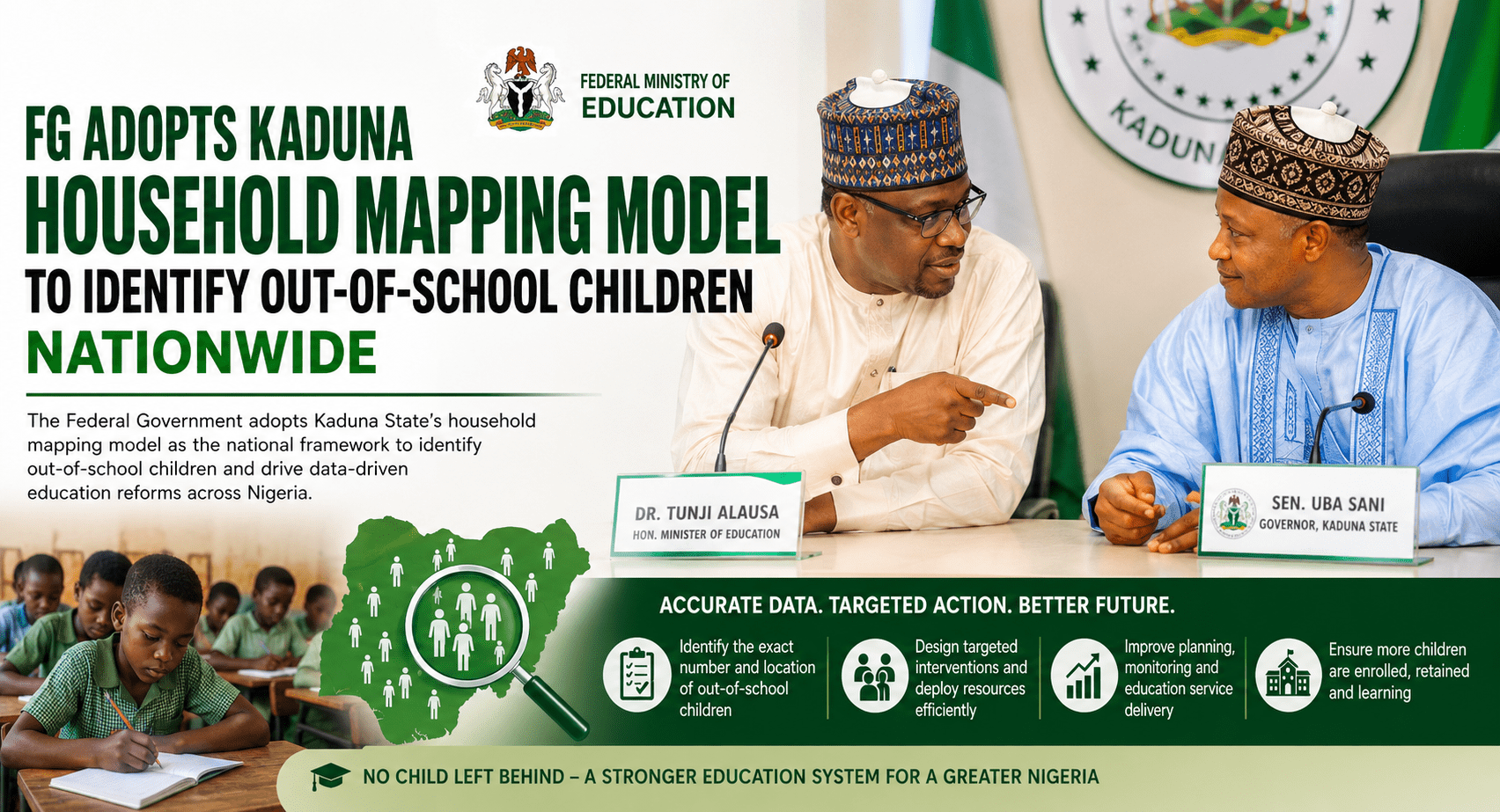
The Federal Government has adopted Kaduna State’s household mapping model as the national framework to identify out-of-school children across Nigeria. Minister of Education, Dr. Tunji Alausa, announced the decision on Thursday after meeting Kaduna State Governor Uba Sani in Abuja. The initiative will use verified household data instead of estimates to locate out-of-school children, improve education planning, and support the Renewed Hope Agenda aimed at increasing school enrolment nationwide.
FG Replaces Estimates With Verified Household Data
The Federal Ministry of Education said the new approach marks a major shift from estimate-based planning to evidence-driven interventions.
According to a statement by the minister’s Special Adviser on Media and Communications, Ikharo Attah, the ministry will work with the National Bureau of Statistics (NBS).
Together, they will conduct a nationwide household mapping exercise across the 36 states and the Federal Capital Territory.
The exercise will identify the exact number of out-of-school children, their locations, and the households they belong to.
As a result, governments will deploy resources more efficiently and design targeted interventions.
Alausa Says Accurate Data Will Improve Education Planning
Speaking after the meeting, Alausa described the initiative as a major step toward addressing Nigeria’s out-of-school children crisis.
He explained that education planning had relied on projections for many years.
However, those estimates often failed to identify where affected children actually lived.
“With this exercise, we now know where these children are and the households they belong to. That gives us the opportunity to work closely with the Kaduna State Government to bring them back to school,” the minister said.
He added that verified data would guide policy decisions and ensure interventions reach children who need them most.
Kaduna Model Reveals Lower Number of Out-of-School Children
Alausa highlighted Kaduna State’s success as proof of the model’s effectiveness.
Previous estimates placed the state’s out-of-school population at about 585,000 children.
However, Kaduna’s household mapping exercise showed the actual figure was fewer than 200,000.
The minister praised Governor Uba Sani for introducing a system that provides a clearer picture of the education challenge.
He noted that accurate data improves planning, resource allocation, and service delivery.
Household Mapping to Become National Standard
According to Alausa, the Federal Ministry of Education has already partnered with the National Bureau of Statistics to replicate the Kaduna model nationwide.
He expressed confidence that the exercise would strengthen education planning and improve monitoring.
Furthermore, the initiative will help identify, enrol, and retain more out-of-school children in schools.
“The nationwide household mapping exercise will provide the accurate data needed to support practical solutions, strengthen collaboration with state governments and development partners, and ensure that more out-of-school children are identified, enrolled and retained in school,” he said.
The minister also reaffirmed that the programme aligns with President Bola Ahmed Tinubu’s Renewed Hope Agenda and will ensure no child is left behind.
Governor Uba Sani Commends Tinubu’s Education Reforms
Governor Uba Sani applauded President Bola Tinubu for prioritising education through sustained federal support.
He said the administration’s commitment has created momentum for meaningful reforms across Nigeria.
The governor also praised Dr. Tunji Alausa and the Minister of State for Education for their leadership.
According to Sani, their reforms continue to inspire state governments to strengthen education systems.
He reaffirmed Kaduna State’s commitment to working closely with the Federal Ministry of Education to expand access to quality education.
Sani described education as one of the most important investments any government can make.
He also expressed satisfaction that Kaduna’s household mapping initiative has now become the national model.
FG Intensifies Efforts to Reduce Out-of-School Children
Nigeria has one of the world’s largest populations of out-of-school children.
Poverty, insecurity, weak infrastructure, and socio-cultural barriers continue to drive the crisis.
To address these challenges, the Federal Government has introduced several reforms under the Renewed Hope Agenda.
These include the Nigerian Education Data Initiative, school infrastructure upgrades, the student loan programme, curriculum reforms, and improved data-driven planning.
The nationwide household mapping exercise is expected to strengthen these initiatives and accelerate progress toward universal access to quality education.