



 By
By Elizabeth Ugbo
President Bola Ahmed Tinubu says his administration is reversing Nigeria’s long-standing economic underperformance through reforms aimed at boosting growth, creating jobs and attracting investment. Speaking on Monday in Abuja at the opening of the 32nd Nigerian Economic Summit, Tinubu, represented by Vice President Kashim Shettima, highlighted economic gains and outlined plans to achieve sustainable growth and shared prosperity.
Tinubu Says Economic Reforms Are Delivering Results
Tinubu said his administration began with difficult economic adjustments because sustainable growth requires deliberate reforms and strong economic foundations.
He explained that the government aims to remove structural barriers that have prevented Nigeria from fully utilising its human and natural resources.
According to him, economic recovery must improve livelihoods and create opportunities for young jobseekers, farmers, manufacturers, entrepreneurs and innovators.
He also stressed the need to stabilise the economy before harnessing opportunities from Nigeria’s growing population.
Furthermore, he said the government must create conditions that encourage public and private sector investment, business expansion and productive employment.
The President noted that the summit’s theme, “Growth That Works: Delivering Jobs, Productivity and Shared Prosperity,” builds on previous efforts to achieve an inclusive and prosperous Nigeria by 2030.
He added that ongoing reforms are restoring confidence, strengthening economic foundations and creating conditions for sustainable growth.
Nigeria Records 3.89% GDP Growth in Q1 2026
Tinubu highlighted economic indicators that, according to him, demonstrate progress under his administration.
He cited National Bureau of Statistics figures showing that Nigeria’s real Gross Domestic Product grew by 3.89% in the first quarter of 2026.
This represents an increase from 3.13% recorded in the corresponding period of 2025.
The President also highlighted progress in economic diversification, noting that non-oil activities accounted for 96.08% of GDP.
Meanwhile, manufacturing grew by 3.29%, while the oil sector recorded 2.57% growth.
Tinubu said these figures reinforced the government’s confidence in its economic recovery and diversification strategy.
However, he maintained that favourable statistics alone cannot deliver the administration’s broader development ambitions.
He said the government must translate economic growth into better jobs, higher productivity and improved living standards.
Foreign Investment Rises to $10.37 Billion
The President disclosed that Nigeria attracted $10.37 billion in capital importation during the first quarter of 2026.
According to him, this represented an 83.83% increase compared with the corresponding period in 2025.
The investment included portfolio investments and foreign direct investment.
Tinubu said the government would continue reducing regulatory burdens, improving transparency and strengthening policy predictability.
He added that expanding access to finance remains essential for businesses seeking to grow and create employment.
Furthermore, he said ongoing tax reforms aim to establish a modern and equitable system that supports development and provides businesses with greater certainty.
Government Targets Better Electricity Supply
Tinubu identified energy, agriculture and solid minerals as important sectors for economic growth and diversification.
He said the government is reforming Nigeria’s electricity market to improve supply and attract investment across the sector.
These efforts cover electricity generation, transmission, distribution and alternative energy sources.
The President stressed that reliable electricity remains essential for industrial expansion, business productivity and job creation.
He also said infrastructure projects should deliver measurable economic benefits rather than merely increase public spending.
Similarly, he argued that education policies must equip Nigerians with practical skills that improve productivity.
He added that industrial policies should strengthen business competitiveness, while investment incentives should attract capital, technology, exports and employment opportunities.
Tinubu Outlines Plans for Agriculture and Solid Minerals
The President said his administration is working to connect farms with storage facilities, processing centres and markets.
The government also plans to expand irrigation, mechanisation, agricultural financing and rural infrastructure.
These measures aim to improve agricultural productivity, reduce post-harvest losses and strengthen market access for farmers.
In the solid minerals sector, Tinubu said Nigeria must move beyond extracting raw materials.
Instead, the government seeks to promote domestic processing, industrial production and exports.
He maintained that these measures would help diversify government revenue, strengthen local industries and create more employment opportunities.
However, Tinubu acknowledged that Nigeria’s economic transformation remains unfinished despite the progress recorded so far.
He also praised young Nigerians for demonstrating their global competitiveness in technology, financial services and creative industries.
UN Deputy Secretary-General Urges Consolidation of Reforms
United Nations Deputy Secretary-General Dr. Amina Mohammed acknowledged the gains from economic reforms under the Tinubu administration.
However, she urged the government to consolidate and stabilise the reforms while managing expectations among citizens and other stakeholders.
Her remarks highlighted the importance of ensuring that economic changes produce lasting benefits for Nigerians.
Mohammed also commended the African Development Bank for developing a new financial architecture to support development across Africa.
She particularly praised its focus on financing programmes designed to deliver measurable development outcomes.
Finance Minister Presents Nigerian Economic Policy Framework
Minister of Finance and Coordinating Minister of the Economy, Dr. Taiwo Oyedele, presented the proposed Nigerian Economic Policy Framework at the summit.
He described the framework as a national economic doctrine that would guide decision-making and measure Nigeria’s economic progress.
Oyedele invited members of the Nigerian Economic Summit Group and private sector experts to review the draft proposal.
He urged stakeholders to provide evidence-based criticism supported by facts and figures.
According to him, the framework rests on three key principles: enterprise, open but fair markets, and whole-of-government coherence.
The proposed framework also prioritises economic stability, human capital development and productivity.
Oyedele said contributions from industry experts would help strengthen the framework and improve its practical application.
NESG Calls for Policy Stability and Implementation
Chairman of the Nigerian Economic Summit Group, Olaniyi Yusuf, said participation at the 32nd summit reflected stakeholders’ commitment to inclusive and sustainable economic growth.
He acknowledged the Federal Government’s efforts to improve Nigeria’s business environment.
However, Yusuf said the priority should be stabilising ongoing reforms rather than reversing the policies.
He stressed that the summit must help Nigeria move beyond policy discussions and develop practical solutions to economic challenges.
According to him, the discussions should produce proposals that promote job creation, improve productivity and deliver shared prosperity.
He also emphasised the need to turn policy agreements into measurable outcomes for businesses and ordinary Nigerians.
BUA Group Chairman Commends Tinubu’s Reforms
Chairman and founder of BUA Group, Abdul Samad Rabiu, commended Tinubu’s economic reforms for addressing longstanding challenges facing Nigerian businesses.
However, he acknowledged that ordinary Nigerians continue to face significant economic difficulties.
Rabiu said improvements in foreign exchange access had created a more predictable operating environment for businesses.
He recalled that companies previously struggled to obtain foreign currency for importing raw materials and machinery, even when they had sufficient naira.
According to him, better access to foreign exchange could help businesses plan operations and meet production needs more effectively.
His remarks highlighted the importance of exchange rate stability and reliable access to foreign currency for industrial growth.
Governors, Ministers and Business Leaders Attend Summit
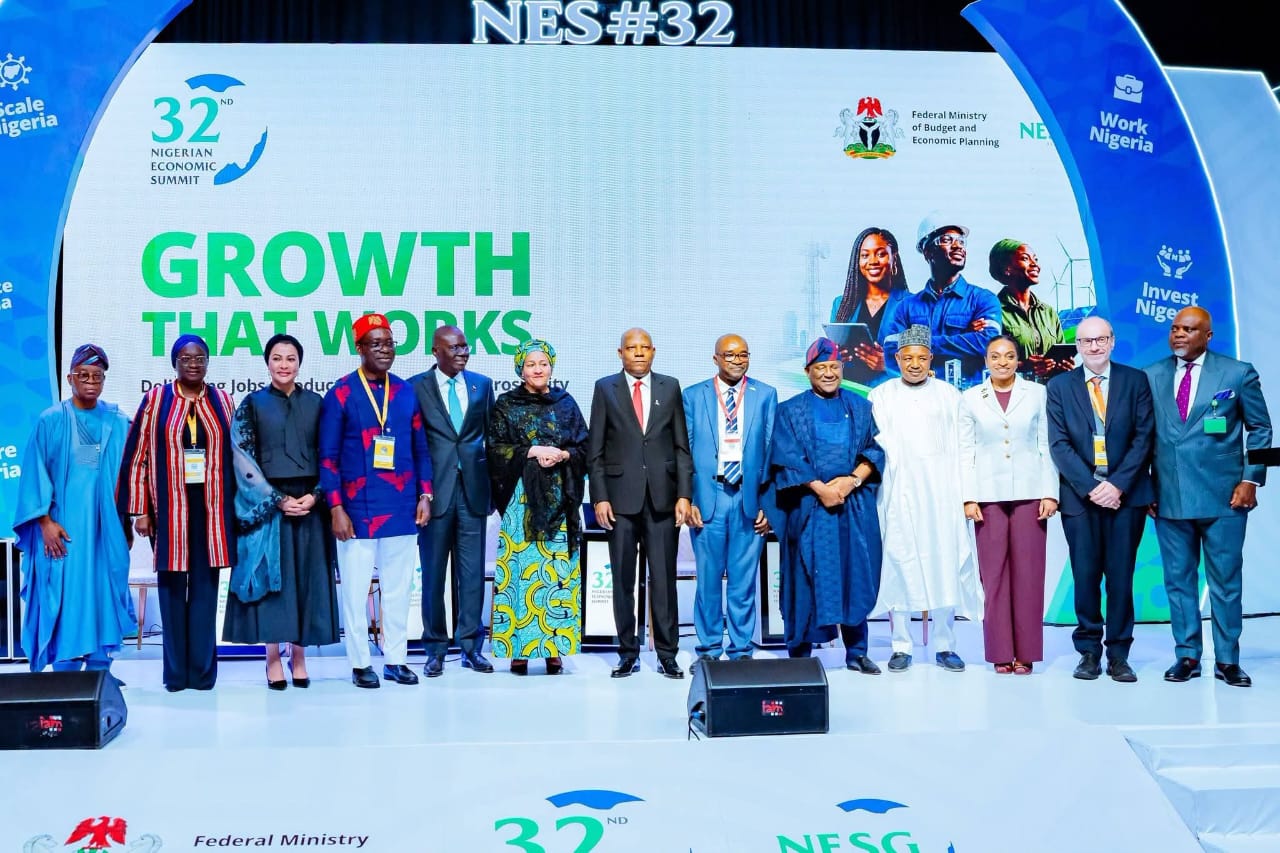
Several government officials, state governors and business leaders attended the opening session of the 32nd Nigerian Economic Summit.
Those present included Anambra State Governor Prof. Chukwuma Soludo and Lagos State Governor Babajide Sanwo-Olu.
Other attendees included Minister of Budget and Economic Planning Senator Abubakar Bagudu and Minister of Industry, Trade and Investment Dr. Jumoke Oduwole.
Minister of Livestock Development Idi Mukhtar Maiha and Minister of State for Budget and Economic Planning Dr. Doris Uzoka-Anite also attended.
Business leaders from Nigeria and other countries participated in the discussions.
The summit provided a platform for government officials, investors and economic experts to discuss strategies for improving productivity and strengthening Nigeria’s economy.
As deliberations continue, stakeholders face the challenge of translating economic reforms into sustainable growth, better employment opportunities and improved living standards for Nigerians.