




 By
By By Elizabeth Ugbo
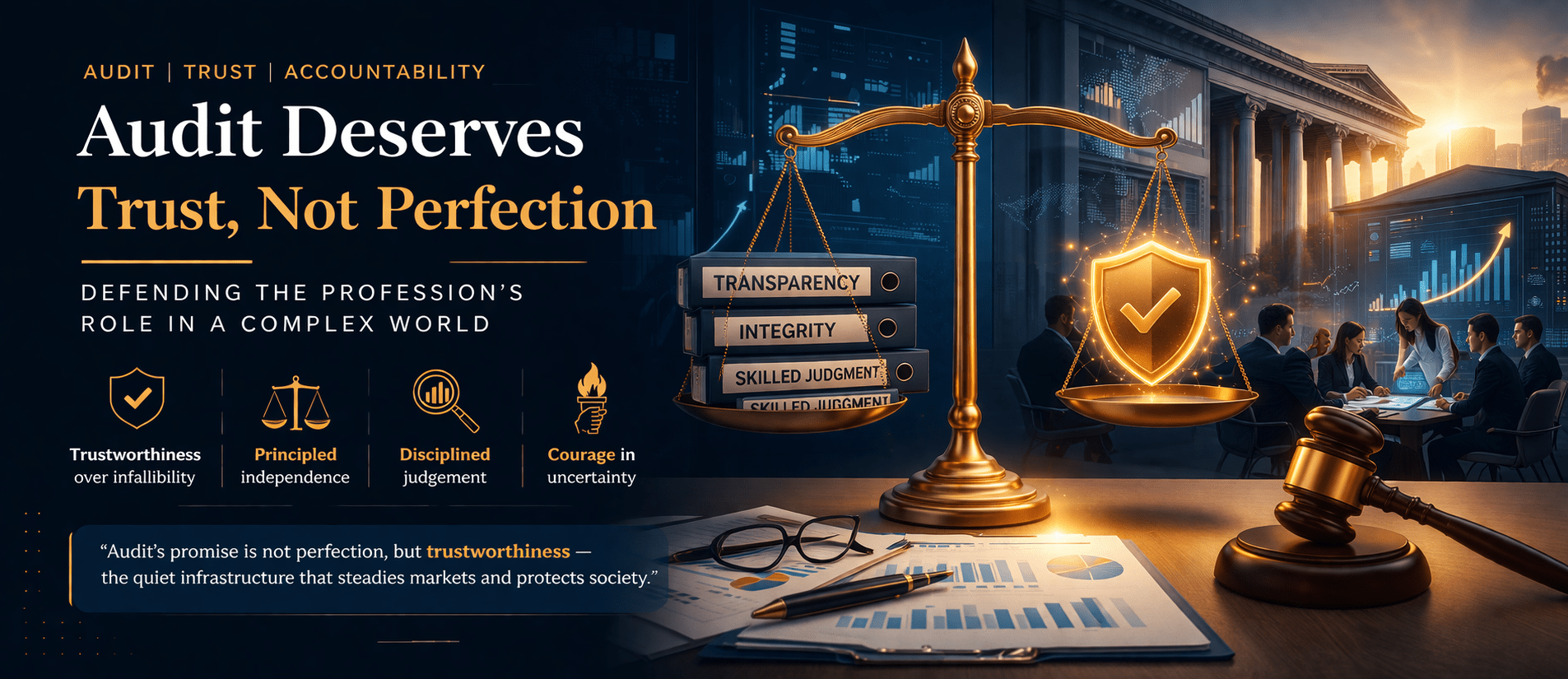
Auditors today, across global financial markets, face intense criticism in the post-Enron era, where companies collapse, and the public demands answers from auditors, even when structural limits exist. Society asks why auditors failed, what they missed, where responsibility lies, how oversight worked, and who should be blamed, often because corporate scandals increased distrust. This pressure grows because people expect perfection from a profession that can only offer disciplined judgment and trustworthiness under uncertainty.
The Rising Burden of Expectations
Modern society often treats auditors as infallible guardians of financial truth. However, audit work operates within complex and uncertain systems. Therefore, even strong processes cannot eliminate all risk.
Moreover, each corporate failure intensifies public scrutiny. As a result, auditors face blame that exceeds their actual control.
Trustworthiness Over Perfection
Audit does not promise certainty. Instead, it delivers trust through disciplined judgment and independent evaluation. Importantly, this trust depends on professional courage.
In addition, auditors must work under incomplete information. They interpret evidence, test assumptions, and form reasonable conclusions. Consequently, errors can occur without implying negligence or misconduct.
The Case of Arthur Andersen
The collapse of Arthur Andersen remains a defining moment in audit history. Public opinion turned quickly during the Enron scandal era. However, later findings showed insider fraud drove the collapse more than audit failure.
Furthermore, the U.S. Supreme Court later overturned Andersen’s conviction. Despite this, the firm had already dissolved. Therefore, narrative pressure shaped outcomes faster than legal clarity.
The Cost of Narrative Momentum
Public narratives often move faster than facts. This speed creates lasting reputational damage. In Andersen’s case, it destroyed a major institution before full evidence emerged.
Additionally, society often forgets long-term professional contributions. Andersen trained generations of auditors and influenced global audit practices. Thus, its loss reduced institutional knowledge across the profession.
Negativity Bias and Public Misunderstanding
People focus more on failure than success. This negativity bias shapes how society views auditing. As a result, one scandal can overshadow decades of reliable work.
Meanwhile, other high-risk professions tolerate failure within limits. Medicine, aviation, and engineering accept error as part of complex systems. However, audit receives less forgiveness.
Why Audit Still Matters
Audit strengthens markets by improving transparency and accountability. It helps investors trust financial reporting systems. Therefore, it supports economic stability at scale.
In addition, auditors act as early warning systems. They detect risks, challenge assumptions, and discourage manipulation. Consequently, they protect public interest even under uncertainty.
A Call for Professional Confidence
The audit profession must speak with clarity and confidence. Silence during crises weakens public understanding. Therefore, professionals should explain limits and defend their role.
At the same time, society must reject perfectionist expectations. No human system can eliminate all error. Instead, systems should focus on reliability and continuous improvement.
Learning From Failure, Not Destroying Institutions
Failures should guide reform rather than trigger destruction. When systems fail, stakeholders should learn and improve them. Consequently, the profession becomes stronger over time.
Deliberate reflection on mistakes can also improve outcomes. It helps organizations avoid complacency and strengthen controls. Therefore, failure becomes a tool for progress, not punishment.
Conclusion
Audit remains a civic technology of trust in an uncertain world. It cannot promise perfection, only disciplined and honest judgment. Therefore, society must value trustworthiness over unrealistic expectations.
When we understand this, we protect institutions, improve governance, and strengthen global financial systems.