




 By
By By Elizabeth Ugbo
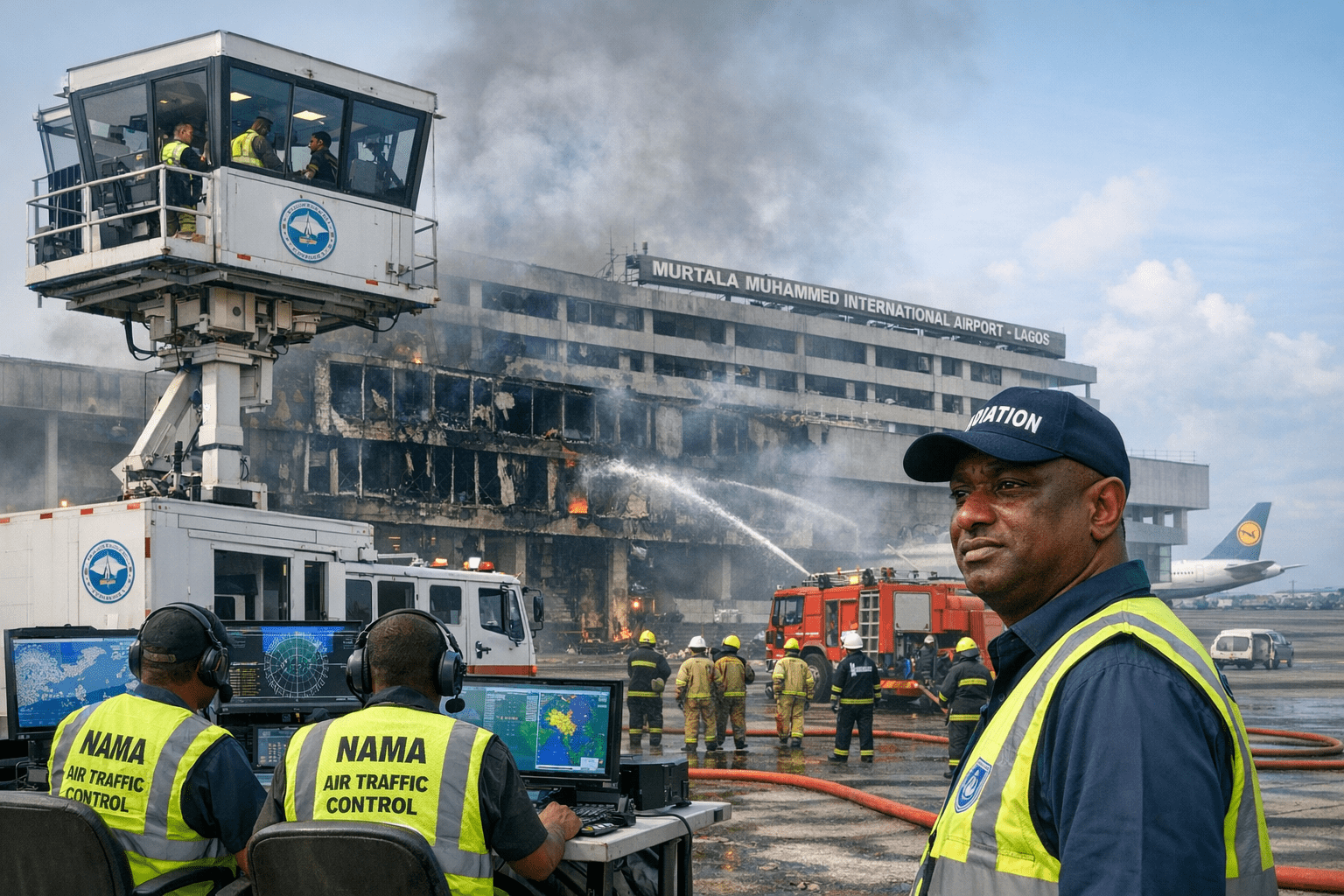
A fire outbreak hit Murtala Muhammed International Airport on February 23, 2026, damaging key aviation infrastructure. The incident occurred on the fourth and fifth floors of Terminal One in Lagos. The Nigerian Airspace Management Agency (NAMA) responded immediately. The agency deployed contingency systems to maintain flight safety and communication with pilots. As a result, Nigeria’s airspace operations continued with minimal disruption.
Quick Response Prevents Major Aviation Disruption
The fire threatened critical air navigation systems used by air traffic controllers. These systems support communication with pilots approaching Lagos airspace.
However, NAMA quickly activated backup infrastructure. The agency also implemented temporary arrangements to sustain air traffic services.
As a precaution, authorities briefly suspended inbound flights into Lagos. Shortly after, controllers restored operations using contingency systems.
Flights diverted to alternative airports, including Malabo and Accra.
Meanwhile, international airlines such as Emirates and Lufthansa resumed Lagos operations shortly after midnight.
National Assembly Lawmakers Commend Aviation Agencies
During an inspection in Lagos, Abdulfatai Buhari, Chairman of the Senate Committee on Aviation, praised the response.
He said aviation agencies met operational expectations during the emergency.
Similarly, Abdullahi Garba, Chairman of the House Committee on Aviation, commended NAMA.
According to him, the agencies stabilised the situation within hours.
He described the emergency response as efficient and well coordinated.
Aviation Minister Praises Emergency Efforts
The Minister of Aviation and Aerospace Development, Festus Keyamo, also inspected the incident scene.
He praised NAMA and other aviation agencies for preventing operational chaos.
The minister also announced government plans to deploy mobile control towers.
These towers will support air traffic controllers while permanent systems undergo restoration.
Mobile Control Tower to Support Flight Operations
Experts say mobile towers include key aviation communication systems.
These systems provide voice communication between pilots and controllers.
They also include weather monitoring technology.
The towers receive weather data from the Nigerian Meteorological Agency (NiMet).
Controllers then use this information to manage aircraft safely.
Why Mobile Tower Deployment Takes Time
NAMA explained that installing aviation infrastructure requires strict technical procedures.
First, engineers must select a location with clear visibility of runways and taxiways.
Next, workers must excavate and cast a strong foundation.
The concrete must cure for at least 21 days before installation.
This process prevents structural instability or operational risk.
Therefore, authorities cannot rush the installation.
Leadership Response from NAMA Management
According to NAMA Managing Director Umar Ahmed Farouk, the agency received the fire alert during a management meeting.
He immediately deployed senior officials to assess the damage.
The Director of Operations and Engineering led the on-ground evaluation.
The team confirmed a major communications loss at the facility.
Consequently, NAMA activated contingency systems to restore operations.
Backup Infrastructure Keeps Nigeria’s Airspace Safe
Modern aviation systems rely on layered backup infrastructure.
These systems prevent a single failure from grounding operations.
NAMA’s contingency response demonstrated operational resilience.
Although the fire destroyed key communication equipment, airspace safety remained intact.
More importantly, coordinated emergency actions prevented a prolonged shutdown.
Aviation Stakeholders Applaud NAMA’s Response
Stakeholders across Nigeria’s aviation sector commended the agency.
Lawmakers and aviation experts praised the quick recovery.
The incident highlighted the importance of preparedness and decisive leadership.
Ultimately, Nigeria’s airspace continued operating safely despite the emergency.