




 By
By By Elizabeth Ugbo
Nigeria has endorsed key institutional reforms within the African Union.
The endorsement was announced at the 39th Ordinary Session in Addis Ababa.
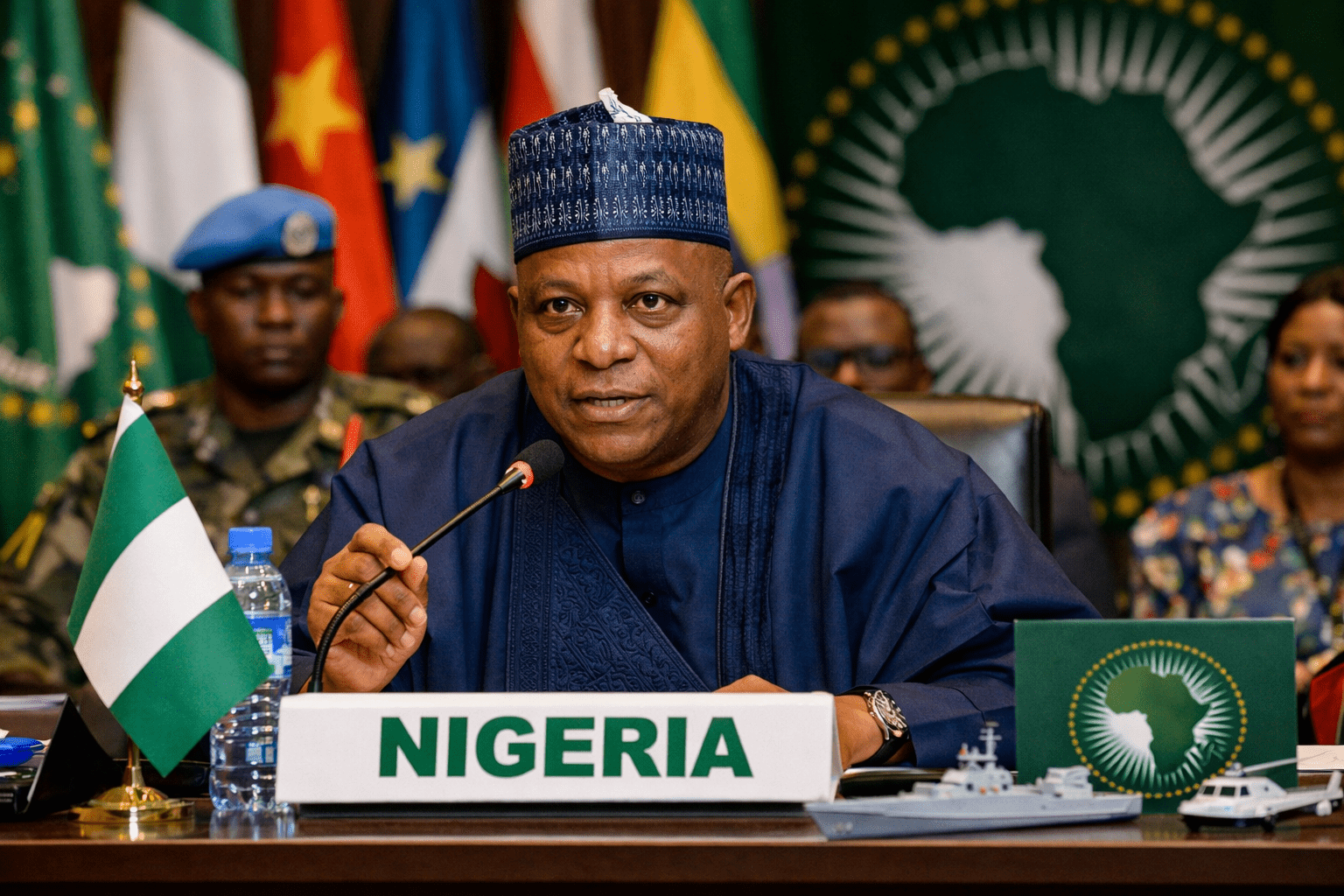
Vice President Kashim Shettima represented President Bola Tinubu at the summit.
He presented Nigeria’s position during a closed session of heads of state.
Accordingly, Nigeria supports reforms focused on peace, security and democratic governance.
The country also backs stronger cooperation with financial institutions and the private sector.
Focus on Peace and Security Governance
Furthermore, Nigeria endorsed reforms to strengthen Africa’s peace and security architecture.
Shettima praised the Peace and Security Council for bold institutional steps.
In addition, he commended the approval of the Combined Maritime Task Force for the Gulf of Guinea.
The force will provide rapid maritime security responses across the region.
Moreover, Nigeria pledged full commitment to establishing the task force headquarters.
As host country, Nigeria will provide offices, ships, helicopters and temporary staff.
He warned that small arms proliferation fuels violent extremism across the region.
Therefore, he urged the union to intensify efforts to curb illegal weapons.
Strengthening Democratic Institutions
On democracy, Nigeria backed reforms to strengthen democratic institutions across Africa.
Similarly, Shettima supported efforts to prevent unconstitutional changes of government.
He welcomed the lifting of suspension on Gabon and Guinea.
Consequently, he urged other transitioning nations to follow due process.
Boosting Resource Mobilisation and Development Financing
Nigeria also aligned with plans to boost domestic and regional resource mobilisation.
Specifically, the reforms aim to ensure affordable development financing.
In addition, the country supports a continental inequality reduction framework.
The framework will rely on credible data, social protection and productive jobs.
Critical Minerals and Industrial Growth
Furthermore, Nigeria described Africa’s mineral resources as strategic development assets.
Shettima stressed that mineral extraction must support local processing and manufacturing.
Therefore, he called for coordinated continental policies on mineral value chains.
He also encouraged regular briefings by African mining ministers for transparency.
Food Security and Agricultural Investment
Meanwhile, Nigeria endorsed the G20 Ubuntu approach on food security.
Additionally, it supports responsible private sector participation in agriculture.
Shettima called for more investment in storage, logistics and research.
He also emphasized climate-resilient agriculture for smallholder farmers.
Finally, Nigeria reaffirmed its commitment to Africa’s food systems transformation.
Other African leaders also contributed to discussions on the reform agenda.