




 By
By By Elizabeth Ugbo
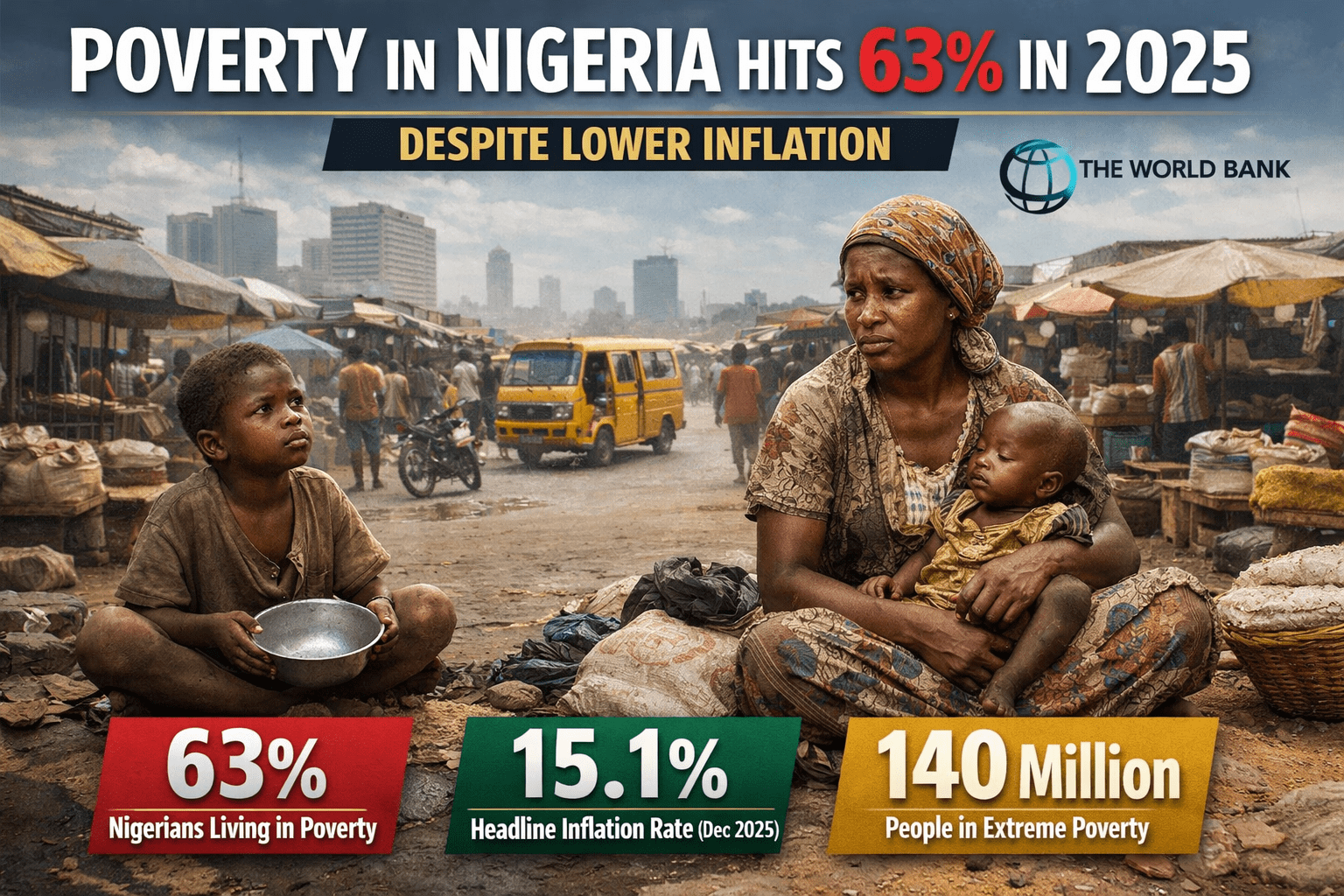
Nigeria’s poverty rate rose to 63% in 2025, affecting about 140 million people, according to the World Bank. The bank revealed this in its Nigeria Development Update (April 2026) titled “Nigeria’s Tomorrow Must Start Today: The Case for Early Childhood Development,” released on Tuesday in Abuja. The report shows that poverty increased despite easing inflation, raising concerns about weak income growth and limited welfare improvement.
Inflation Declines but Living Conditions Remain Tough
Headline inflation dropped sharply from 34.80% in December 2024 to 15.15% in December 2025. Food inflation also fell from 39.84% to 10.84% within the same period.
However, the World Bank stressed that inflation still erodes purchasing power. As a result, many households continue to struggle with rising living costs.
Moreover, income growth has not kept pace with prices. This gap has prevented meaningful improvements in living standards.
Weak Income Growth Slows Poverty Reduction
The report highlighted a major concern: real incomes remain low. Although inflation slowed, previous price spikes already weakened household finances.
Therefore, the recent decline in inflation has not yet translated into better welfare. Instead, many Nigerians still face reduced purchasing power.
In addition, global shocks—especially conflicts in the Middle East—have pushed up energy, food, and transport costs.
Structural Challenges Hold Back Progress
The World Bank identified key structural issues limiting poverty reduction. Economic growth mainly comes from services and industry. Meanwhile, agriculture—where most poor Nigerians work—lags behind.
This imbalance has reduced income gains among vulnerable populations. Consequently, economic growth has not significantly improved living standards.
Low agricultural productivity, weak job creation, and persistent inequality continue to slow progress.
Job Creation and Inclusive Growth Are Critical
Speaking at the report launch, World Bank Lead Economist for Nigeria, Fiseha Haile, stressed the importance of inclusive growth.
He explained that economic expansion alone cannot reduce poverty. Instead, growth must create jobs and raise incomes, especially for vulnerable groups.
Furthermore, he emphasized that price stability remains essential for improving living conditions.
Early Childhood Investment Key to Long-Term Gains
The report also linked poverty to human capital challenges. Poor households often face worse outcomes in nutrition, health, and education.
Therefore, the World Bank urged stronger investment in early childhood development. Such investments can boost productivity and reduce long-term inequality.
In contrast, neglecting this sector will deepen poverty cycles across generations.
Poverty Outlook: Slow Decline Expected by 2028
Looking ahead, the World Bank projects a gradual decline in poverty starting from 2026. The rate may fall to about 59% by 2028.
This improvement will depend on lower food inflation and stable macroeconomic conditions.
However, progress will remain slow. Weak job creation and structural constraints will likely limit faster gains.
Conclusion
Nigeria’s rising poverty rate highlights a disconnect between economic growth and real income gains. Although inflation has eased, many households still struggle.
To reverse this trend, policymakers must focus on job creation, agricultural growth, and inclusive policies. Without these steps, poverty reduction will remain slow and uneven.