



 By
By By Elizabeth Ugbo
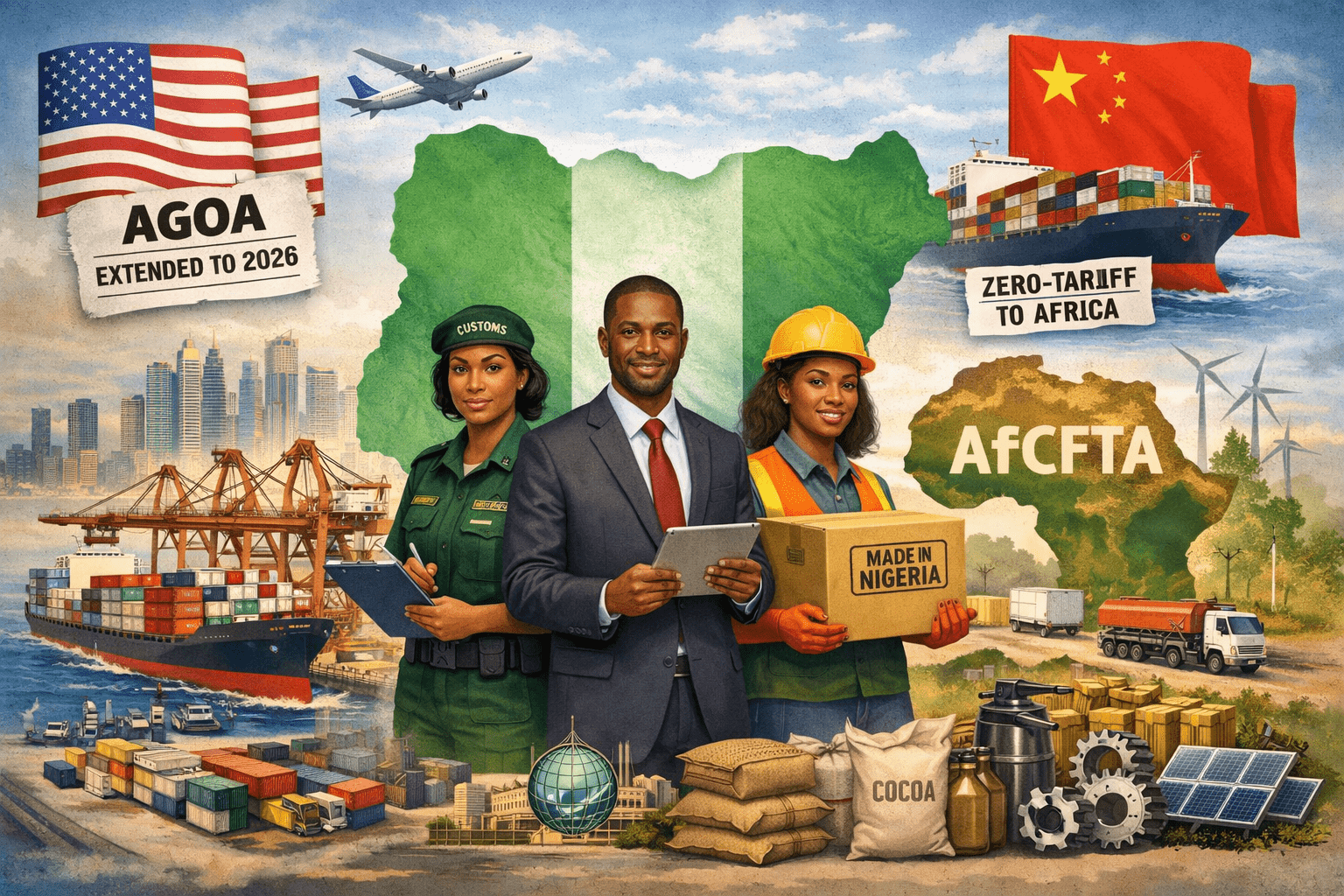
Nigeria faces a shifting global trade environment as the United States extends the African Growth and Opportunity Act (AGOA) only until 31 December 2026, while China introduces zero-tariff access for imports from 53 African countries starting 1 May 2026. These developments affect Nigeria and other African economies that depend on export markets. Policymakers, businesses, and investors must therefore understand what these trade changes mean, why they matter, and how Nigeria should respond. The central question now is how Nigeria can convert these external opportunities into jobs, industrial growth, and stronger economic influence.
Global Trade Is Becoming More Strategic
The global trade environment is changing rapidly. Major powers now use trade access as a strategic tool.
The United States recently reauthorised the African Growth and Opportunity Act (AGOA) until December 2026, with retroactive effect to September 2025. This extension preserves duty-free access for eligible African exports. However, the short timeline creates uncertainty for investors and exporters.
At the same time, China has announced a zero-tariff regime for imports from 53 African countries with diplomatic relations. This policy will begin on 1 May 2026.
Together, these decisions reveal a wider trend. Trade preferences now reflect geopolitical competition and strategic economic interests.
Nigeria must therefore treat trade policy as a core instrument of national strategy rather than a secondary diplomatic issue.
Why Market Access Alone Is Not Enough
Market access offers opportunity, but it does not guarantee success.
Countries that benefit most from new trade preferences will meet strict export standards, improve logistics, and scale production quickly. They will also move beyond raw commodity exports toward higher-value goods.
For Nigeria, this reality creates an important challenge. The country must strengthen its export readiness.
Producers must meet certification standards, improve product quality, and solve transport bottlenecks. Efficient customs processes and reliable logistics will also determine success.
Without these capabilities, tariff advantages will produce limited economic gains.
Nigeria’s Strategic Trade Challenge
Nigeria cannot approach global trade shifts passively. The country’s economic size and diplomatic influence require a proactive strategy.
Economic diplomacy should therefore focus on measurable outcomes. These include increased export volumes, stronger value addition, and diversified trade relationships.
Success should also appear in stronger domestic industries and greater economic resilience.
Trade frameworks alone cannot deliver these outcomes. Nigeria must build institutions that help businesses enter and succeed in international markets.
Strengthening Nigeria’s Trade Foundations
Nigeria has already taken several positive steps to strengthen its trade position under the African Continental Free Trade Area (AfCFTA).
In April 2025, the government gazetted its provisional schedule of tariff concessions. It also launched a market intelligence platform to help exporters identify opportunities.
Another milestone came on 9 March 2026. Nigeria signed the host country agreement for the fifth Intra-African Trade Fair 2027 with African Export–Import Bank, African Union Commission, and the AfCFTA Secretariat.
The agreement confirmed Lagos as the host city for the major continental trade event in November 2027.
President Bola Ahmed Tinubu has also emphasized the need for efficient African borders and stronger intra-African trade.
These steps provide a strong foundation for Nigeria’s trade strategy.
The Importance of Institutional Coordination
Effective trade diplomacy requires coordination across multiple government institutions.
Foreign Affairs, Trade and Investment, Finance, Customs, and standards agencies must work together. Export promotion agencies and sector regulators must also align their efforts.
Trade barriers rarely involve tariffs alone. They also include rules of origin, customs delays, certification requirements, and logistics inefficiencies.
Therefore, Nigeria must build systems that allow firms to move goods across borders quickly and reliably.
Stronger institutional coordination will help Nigerian exporters compete globally.
Focus on High-Value Export Sectors
Nigeria must also apply stronger sectoral discipline in export development.
Not every export opportunity supports long-term industrial growth. Some markets simply encourage raw commodity exports.
Instead, Nigeria should prioritize sectors that strengthen domestic production capacity.