




 By
By By Elizabeth Ugbo
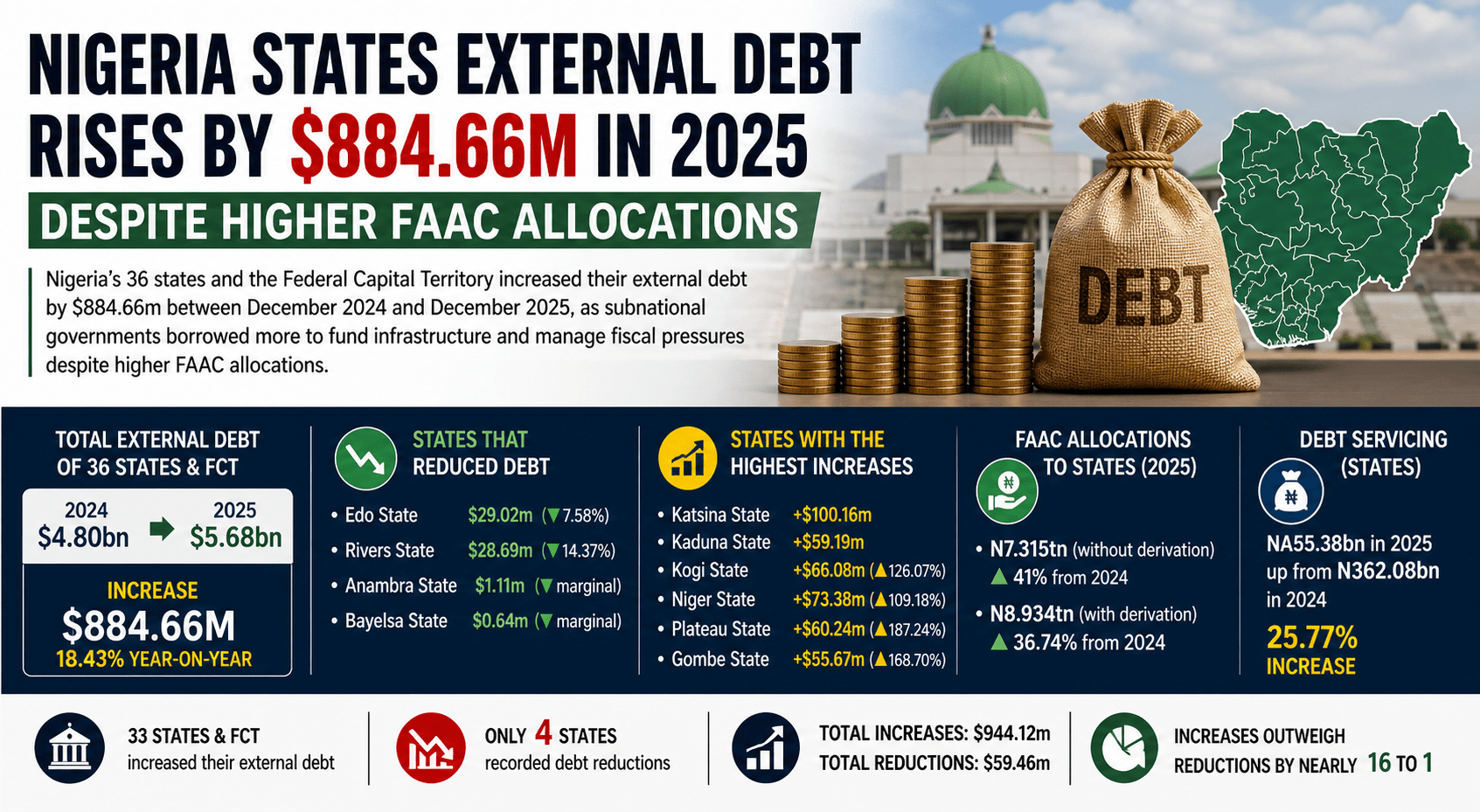
Nigeria’s 36 states and the Federal Capital Territory increased their external debt by $884.66m between December 2024 and December 2025, according to data from the Debt Management Office, as subnational governments borrowed more to fund infrastructure and manage fiscal pressures despite higher FAAC allocations.
Few States Reduce Debt
Only a handful of states reduced their foreign debt during the period.
Edo State recorded the largest drop, cutting $29.02m, a 7.58% decline. Rivers State followed with a $28.69m reduction, down 14.37%.
Anambra State reduced its debt by $1.11m, while Bayelsa State posted a marginal decline of $0.64m.
However, these reductions did not change the overall upward trend.
Sharp Increases Across Many States
Most states increased their borrowing significantly.
Katsina State recorded one of the largest jumps, adding $100.16m and nearly doubling its debt. Kaduna State also rose sharply, adding $59.19m to reach $684.29m.
Kogi State posted a 126.07% increase, while Niger State more than doubled its debt with a 109.18% rise.
Plateau State recorded the highest percentage increase at 187.24%.
Gombe State followed with a 168.70% rise, while Benue and Yobe states recorded increases of 128.16% and 136.56% respectively.
Imo State’s debt grew by 63.90%, while Oyo State rose by 65.73%.
Lagos Shows Cautious Borrowing
Lagos State remained the most externally indebted state. However, it recorded only a marginal increase of $4.83m, representing 0.41% growth.
This slower growth suggests a more cautious borrowing approach compared to other states.
Moderate Increases in Other Regions
Several states posted moderate increases in their debt levels.
Cross River added $20.46m, while Bauchi increased by $33.75m. Ogun State rose by $24.10m, and Ondo recorded an $8.25m increase.
In the South-East, Ebonyi added $16.94m, Enugu increased by $12.83m, and Abia recorded a $5.69m rise.
Adamawa State posted a $26.03m increase, while Akwa Ibom rose by $19.90m. Delta and Ekiti recorded smaller increases of $6.28m and $1.73m respectively.
The Federal Capital Territory also recorded a $7.31m increase, representing a 37.53% rise.
Multilateral Loans Dominate Borrowing
Most external loans came from multilateral institutions. States showed limited reliance on bilateral and commercial lenders.
FAAC Allocations Surge in 2025
FAAC allocations to states increased significantly during the period.
States received N7.315tn in 2025, compared to N5.186tn in 2024, marking a 41% rise.
When derivation revenue is included, total inflows reached N8.934tn, representing a 36.74% increase.
Overall FAAC distributions rose to N21.897tn in 2025.
Debt Servicing Costs Climb
Debt servicing costs also increased sharply.
States paid N455.38bn in foreign debt servicing in 2025, up from N362.08bn in 2024.
This 25.77% increase reduced funds available for salaries, infrastructure, and governance.
Experts Warn Over Fiscal Pressure
Experts have raised concerns about fiscal sustainability.
A report by NEITI indicates that states with high debt burdens often rank lower in FAAC allocations while recording higher debt deductions.
Analysts advise states to improve internally generated revenue and reduce waste.
Borrowing Far Outpaces Debt Reduction
The data highlights a clear imbalance.
Thirty-three states and the FCT increased their external debt, while only four states recorded reductions.
Total increases reached $944.12m, compared to $59.46m in reductions.
As a result, borrowing outweighed debt reduction by nearly 16 to 1.
Key Takeaways
External debt rose by $884.66m in 2025. Most states expanded borrowing despite higher FAAC inflows. Rising debt servicing costs continue to pressure state finances.