



 By
By Elizabeth Ugbo
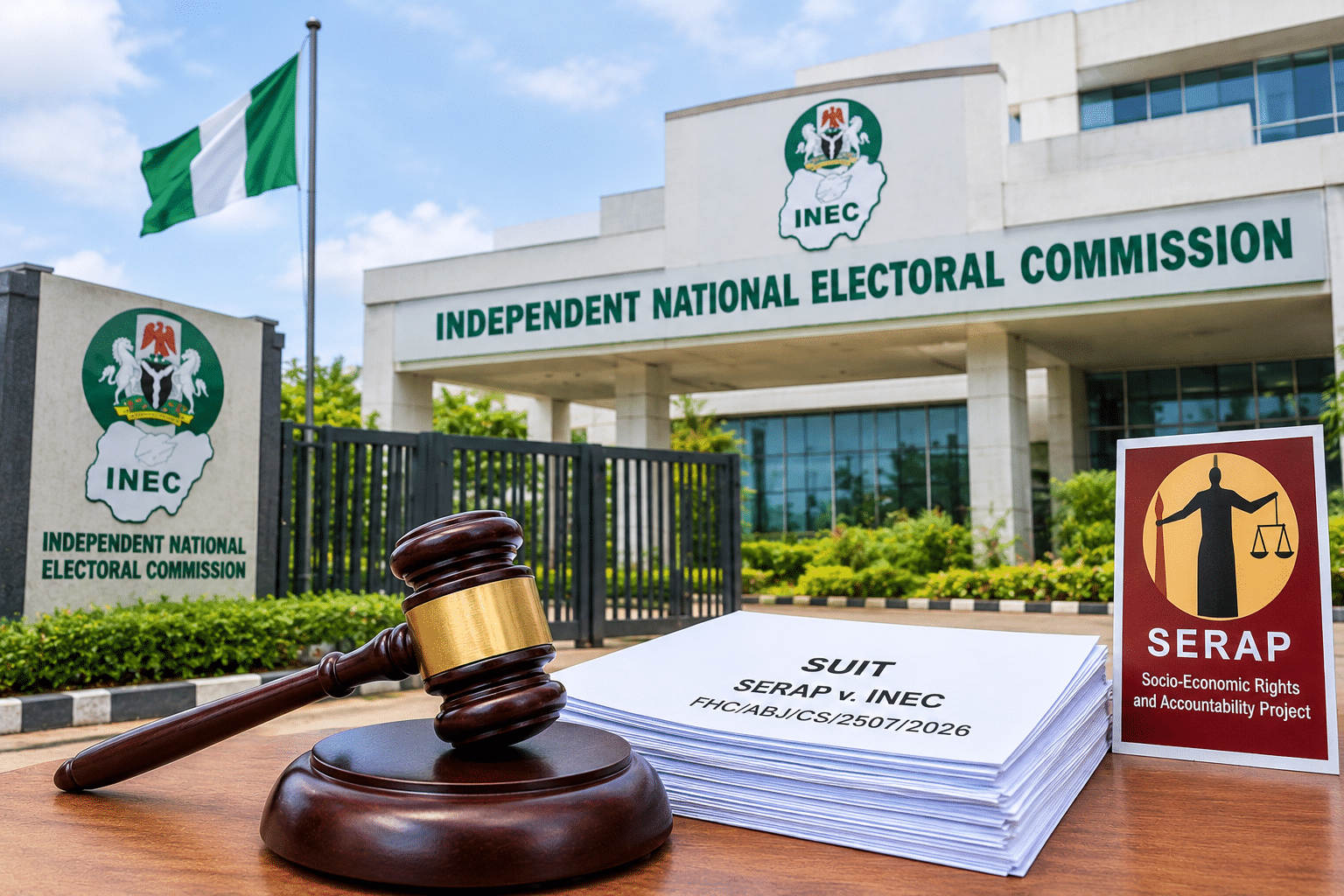
The Socio-Economic Rights and Accountability Project (SERAP) has sued the Independent National Electoral Commission (INEC) at the Federal High Court in Abuja over its alleged failure to account for more than N126.46 billion allocated for electoral operations. The suit seeks transparency over how the commission spent the funds on election materials, equipment, vehicles and other services ahead of Nigeria’s 2027 general elections.
SERAP Seeks Full Disclosure of Electoral Funds
The suit, marked FHC/ABJ/CS/2507/2026, asks the court to compel INEC to disclose details of the expenditure, utilisation and disbursement of the funds.
SERAP also seeks a comprehensive financial and documentary account of the money. This includes amounts released, payments made, beneficiaries, contractors and their beneficial owners.
The organisation filed the suit through its lawyers, Kolawole Oluwadare, Kehinde Oyewumi and Andrew Nwankwo.
It based the action on allegations contained in the 2023 audited report of the Auditor-General of the Federation, published on August 7, 2026.
According to SERAP, the report identified several transactions involving billions of naira allegedly spent without proper procurement procedures or sufficient evidence of delivery.
The organisation argued that the allegations raise serious concerns about public financial management and accountability.
“Electoral resources are public resources. INEC must be able to account for every naira, demonstrate that it was lawfully spent and show that it served the purposes for which it was appropriated,” SERAP stated.
Auditor-General Flags N112bn Procurement Concerns
SERAP said the Auditor-General identified an alleged payment of N112,155,597,845 for ballot boxes, electoral devices and other election materials.
According to the suit, INEC allegedly made the payments without competitive bidding or a certificate of no objection from the Bureau of Public Procurement (BPP).
The report reportedly questioned whether the commission procured the items. It also raised concerns about the contractors’ qualifications and business locations.
The Auditor-General reportedly noted that the companies’ competencies, experience, capacities, addresses and factory locations remained unknown.
SERAP urged the court to compel INEC to provide documentary and physical evidence confirming the procurement and delivery of the materials.
It also wants the commission to disclose their current locations and conditions.
Alleged Irregular Payments for Election Materials
The organisation highlighted several other transactions that allegedly breached procurement requirements.
According to the suit, INEC paid N3,136,806,050 to four contractors for ballot guides, sensitive materials and result sheets before awarding the contracts.
The Auditor-General reportedly raised concerns about possible diversion and recommended recovering the funds for remittance to the treasury.
SERAP also cited N9,245,965,502.60 in payments for 22 contracts covering similar goods and services.
The contracts allegedly went to contractors on the same day after officials split them to circumvent procurement procedures.
The report reportedly questioned whether the contractors supplied the items covered by the payments.
Additionally, SERAP alleged that INEC paid N504,492,641 for accreditation devices without following due procurement procedures.
Questions Over Vehicles and Consultancy Payments
SERAP also raised concerns about payments for vehicles and professional services.
The organisation alleged that INEC spent N1,058,925,000 on Toyota Prado TXL 2021 model vehicles without advertising or competitive bidding.
It further alleged that the commission failed to conduct bid evaluations or obtain a certificate of no objection from the BPP.
According to the suit, the Auditor-General warned that the funds might have been lost and the contracts inflated.
SERAP also cited an alleged payment of N129.375 million to 19 accounting firms for financial audit services.
The report reportedly found no evidence of utilisation, requests or expenditure by the consultants.
Consequently, the Auditor-General recommended recovering the funds over concerns about possible diversion.
Another transaction involved an alleged payment of N235.103 million to contractors described as unqualified.
The payments reportedly covered sleeping mats and digital archiving services. The Auditor-General questioned the contractors’ eligibility and capacity.
Software Licence and Security Equipment Payments
The suit also highlighted concerns about payments involving software and security equipment.
SERAP said the Auditor-General questioned the value for money from a security licence transaction.
According to the report, the Advanced Persistent Gateway (APG) had expired before officials delivered the security licence key.
Meanwhile, the software remained valid for only four months, raising concerns about the value received.
The Auditor-General reportedly warned that the funds might have been lost.
SERAP argued that INEC must provide evidence showing that the disputed payments delivered the intended services and equipment.
SERAP Wants Contractors and Officials Identified
Beyond financial disclosure, SERAP wants the court to compel INEC to identify contractors, suppliers and consultants who allegedly received irregular payments.
It also seeks the names of public officials who authorised, processed, facilitated or benefited from the transactions.
The organisation said Nigerians deserve to know whether contractors delivered the goods and services covered by their agreements.
It also questioned whether payments matched actual deliveries and whether officials deliberately divided contracts to evade procurement rules.
Furthermore, SERAP urged the court to prevent INEC from disposing of, transferring, destroying or writing off electoral equipment linked to the Auditor-General’s findings.
It warned that such actions could frustrate investigations and undermine accountability.
SERAP Cites Constitutional and International Obligations
SERAP argued that the alleged irregularities raise questions about INEC’s compliance with constitutional provisions, anti-corruption laws and procurement regulations.
It cited Section 15(5) of the Nigerian Constitution, which requires the state to abolish corrupt practices and abuse of power.
The organisation also referenced Section 13, which requires public institutions to observe and apply the Constitution’s provisions.
Additionally, SERAP cited Nigeria’s obligations under the United Nations Convention against Corruption.
It also referenced the International Covenant on Civil and Political Rights and the African Charter on Human and Peoples’ Rights.
According to SERAP, Article 25 of the international covenant and Article 13 of the African Charter protect citizens’ rights to participate in public affairs.
The organisation said accountability remains essential because INEC manages resources that directly support Nigeria’s electoral process.
SERAP Warns Ahead of 2027 General Elections
SERAP stressed that transparent management of electoral funds is particularly important ahead of the 2027 general elections.
The organisation said proper accountability would help protect public confidence in the electoral process.
“With the 2027 general elections approaching, transparency and accountability in the management of these funds are essential to safeguarding public confidence in the electoral process and ensuring that resources intended to support credible elections are properly utilised,” SERAP stated.
It maintained that Nigerians have the right to know how public institutions spend taxpayers’ money.
The organisation also urged INEC to preserve all relevant records and electoral assets while the case proceeds.
No date has been fixed for the hearing of the suit.