




 By
By By Elizabeth Ugbo
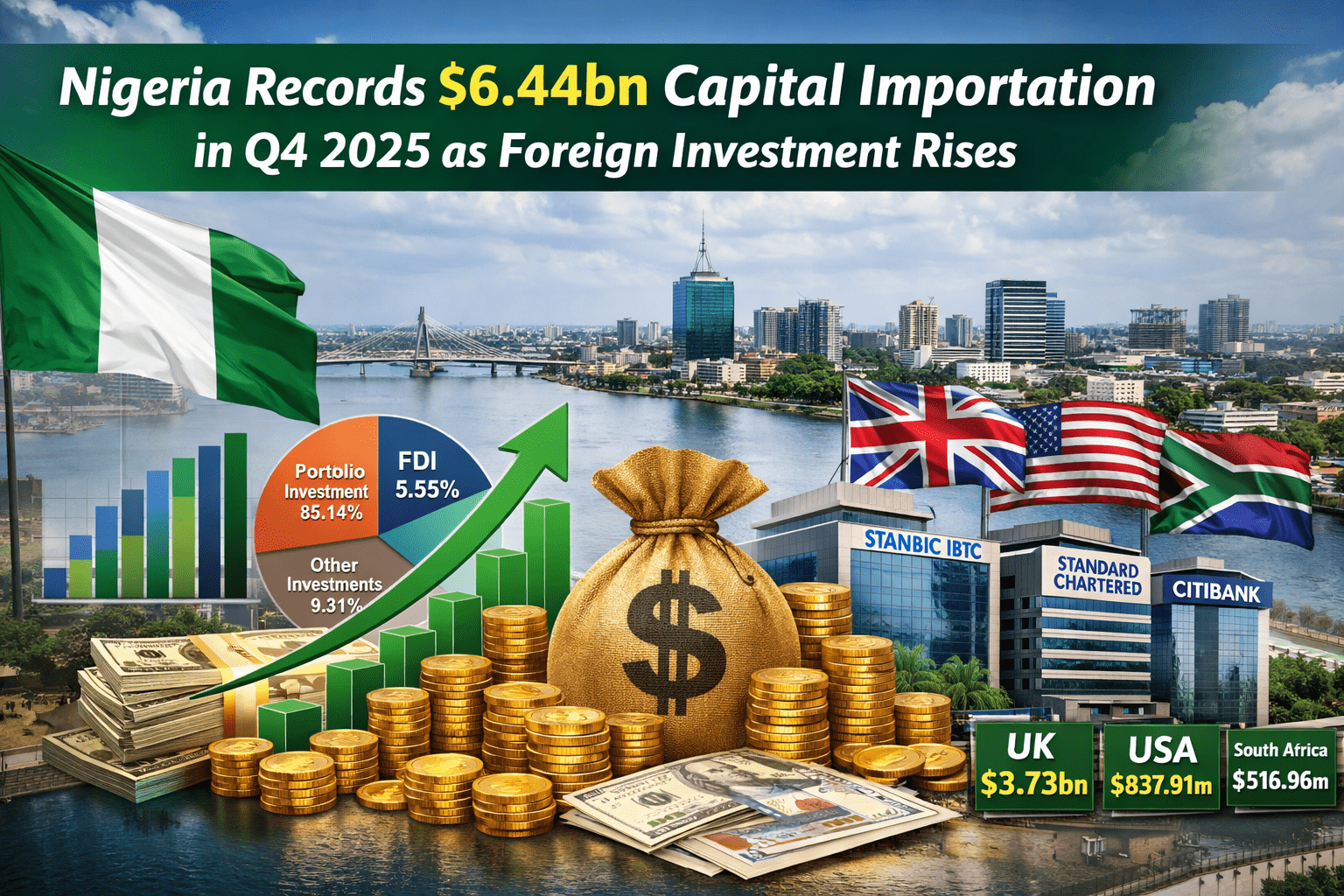
Nigeria recorded a total capital importation of $6.44bn in the fourth quarter of 2025, according to the National Bureau of Statistics. The data, released on Wednesday, shows that foreign investments into Nigeria increased both year-on-year and quarter-on-quarter, reflecting improved investor confidence in the country’s financial markets.
Capital Importation Shows Strong Growth
Total capital inflows rose by 26.61 per cent from $5.09bn recorded in Q4 2024. Similarly, inflows increased by 7.13 per cent from $6.01bn in Q3 2025.
This steady rise signals sustained improvement in foreign investment. It also highlights renewed interest in Nigeria’s economy despite global uncertainties.
Portfolio Investment Dominates Inflows
Portfolio investment remained the largest contributor, accounting for $5.49bn or 85.14 per cent of total inflows.
In contrast, Foreign Direct Investment contributed $357.80m, representing 5.55 per cent. Other investments stood at $599.65m or 9.31 per cent.
Moreover, money market instruments attracted $3.08bn, while bonds contributed $1.97bn. This trend shows investors prefer short-term and fixed-income assets.
Banking Sector Attracts Majority Share
The banking sector received the highest inflows, attracting $3.85bn or 59.75 per cent of total capital.
The financing sector followed with $1.94bn, accounting for 30.15 per cent. Meanwhile, the production sector recorded $308.93m or 4.79 per cent.
However, sectors like telecommunications, agriculture, and oil and gas attracted lower investments. This pattern shows heavy concentration in financial services.
United Kingdom Leads Investment Sources
The United Kingdom emerged as the top source of capital, contributing $3.73bn or 57.94 per cent.
The United States followed with $837.91m, representing 13.00 per cent. South Africa accounted for $516.96m or 8.02 per cent.
Additionally, Belgium and Mauritius ranked among notable contributors.
Top Banks Driving Capital Inflows
Stanbic IBTC Bank Plc led with $2.23bn, representing 34.58 per cent of total inflows.
Standard Chartered Bank Nigeria Limited followed with $1.85bn or 28.75 per cent. Citibank Nigeria Limited recorded $840.72m, accounting for 13.05 per cent.
Other banks, including Access Bank Plc, Rand Merchant Bank, and First City Monument Bank, posted smaller shares.
Investor Sentiment Improves, But Challenges Remain
The data indicates stronger investor confidence, especially in financial markets.
However, low Foreign Direct Investment shows that long-term investments in the real sector remain weak. This gap suggests the need for policies that attract sustainable capital.