




 By
By By Elizabeth ugbo
The 2025 Global Mind Health Report released on Wednesday by Sapien Labs reveals that 41 percent of young adults aged 18 to 34 across 84 countries are experiencing a “mind health crisis,” with researchers warning that rising psychological distress threatens productivity, relationships, and long-term economic stability worldwide.
The study draws from data collected from nearly one million respondents through the Global Mind Project. Researchers used the Mind Health Quotient (MHQ) to measure 47 dimensions of emotional, social, cognitive, and physical functioning.
African Countries Dominate Youth Mental Health Rankings
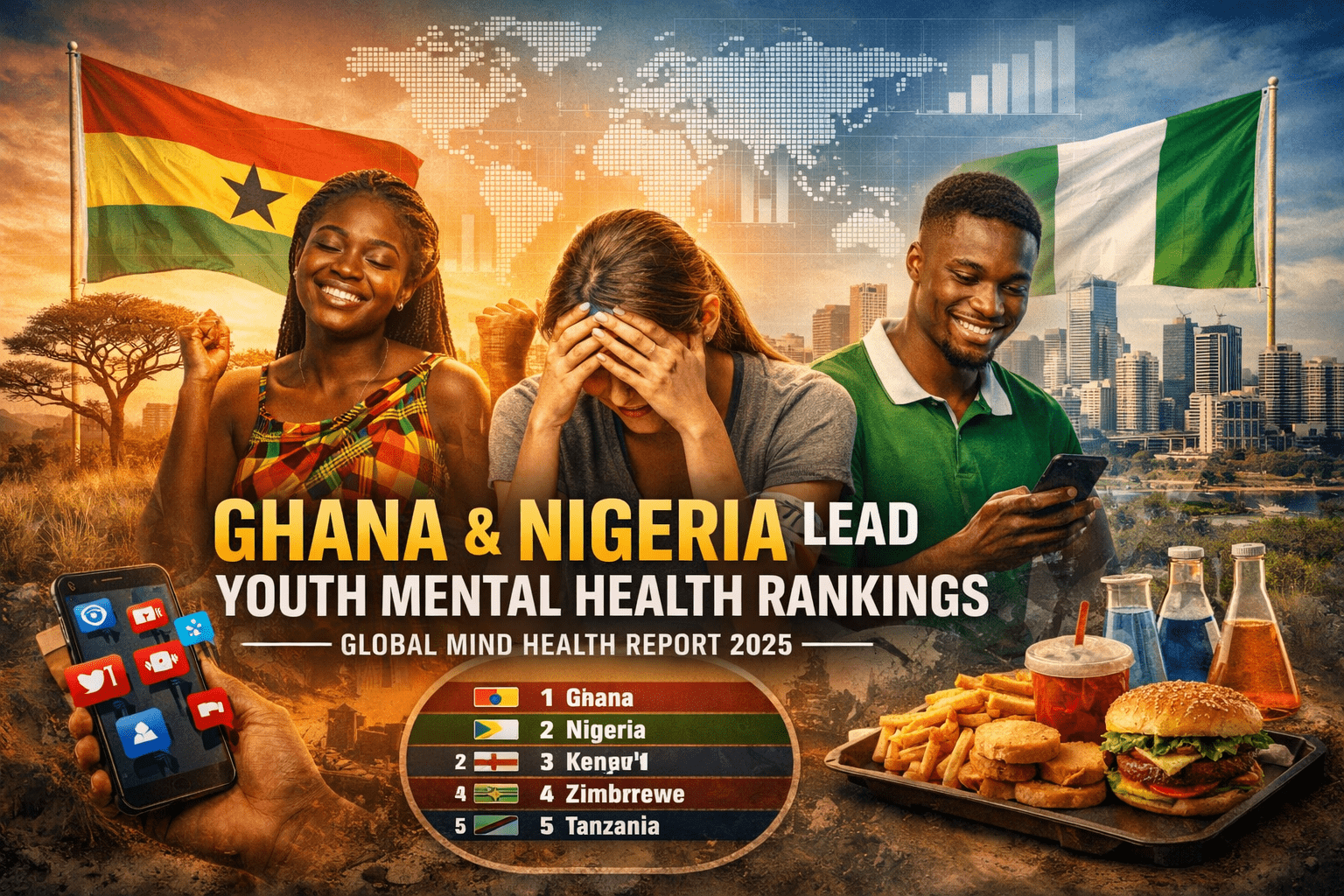
According to the report, Ghana ranked first globally in youth mind health. Nigeria placed second, followed by Kenya, Zimbabwe, and Tanzania.
Notably, all top five nations came from sub-Saharan Africa. In contrast, high-income countries such as the United States, Canada, Japan, and Australia ranked near the bottom.
Researchers advised African nations to protect their cultural strengths. They stressed that generational decline could still occur without preventive action.
Nigeria’s Mind Health Quotient Performance
Nigeria recorded strong MHQ results across age groups. Young adults aged 18–34 scored 64, placing the country second out of 84 nations. Older adults ranked 10th globally with a higher score of 113.
However, the report identified warning signs. Family closeness dropped from 80 percent among adults aged 55 and above to 61 percent among those aged 18–34. In addition, younger respondents reported earlier smartphone exposure during childhood.
Despite these concerns, both age groups ranked high in spirituality. Young adults placed 13th globally, while older adults ranked 7th.
Experts Warn of Economic Consequences
Tara Thiagarajan, founder and chief scientist of Sapien Labs, said the crisis extends beyond depression and anxiety. She explained that many young adults struggle with emotional regulation, focus, and relationships.
Meanwhile, David Blanchflower, professor of economics at Dartmouth College, warned that widespread distress among young adults could weaken entire economies. He noted that nearly half of the global core workforce faces mental health challenges.
Furthermore, the report highlighted a sharp generational reversal. In the early 2000s, young adults ranked as the healthiest group mentally. Today, they are four times more likely than adults over 55 to experience clinical-level challenges.
Policy Recommendations to Address the Crisis
Although Western nations have increased mental health spending by billions of dollars, researchers said the investments have not delivered significant improvements. Therefore, they called for broader policy reforms.
Key recommendations include restricting smartphone use during school hours, setting minimum age limits for social media access, and strengthening regulation of additives in ultra-processed foods. Researchers also urged governments to expand research into lifestyle and environmental factors affecting mental well-being.
Ultimately, the report concludes that protecting youth mental health requires preventive action, stronger social systems, and coordinated global policies.