




 By
By By Elizabeth Ugbo
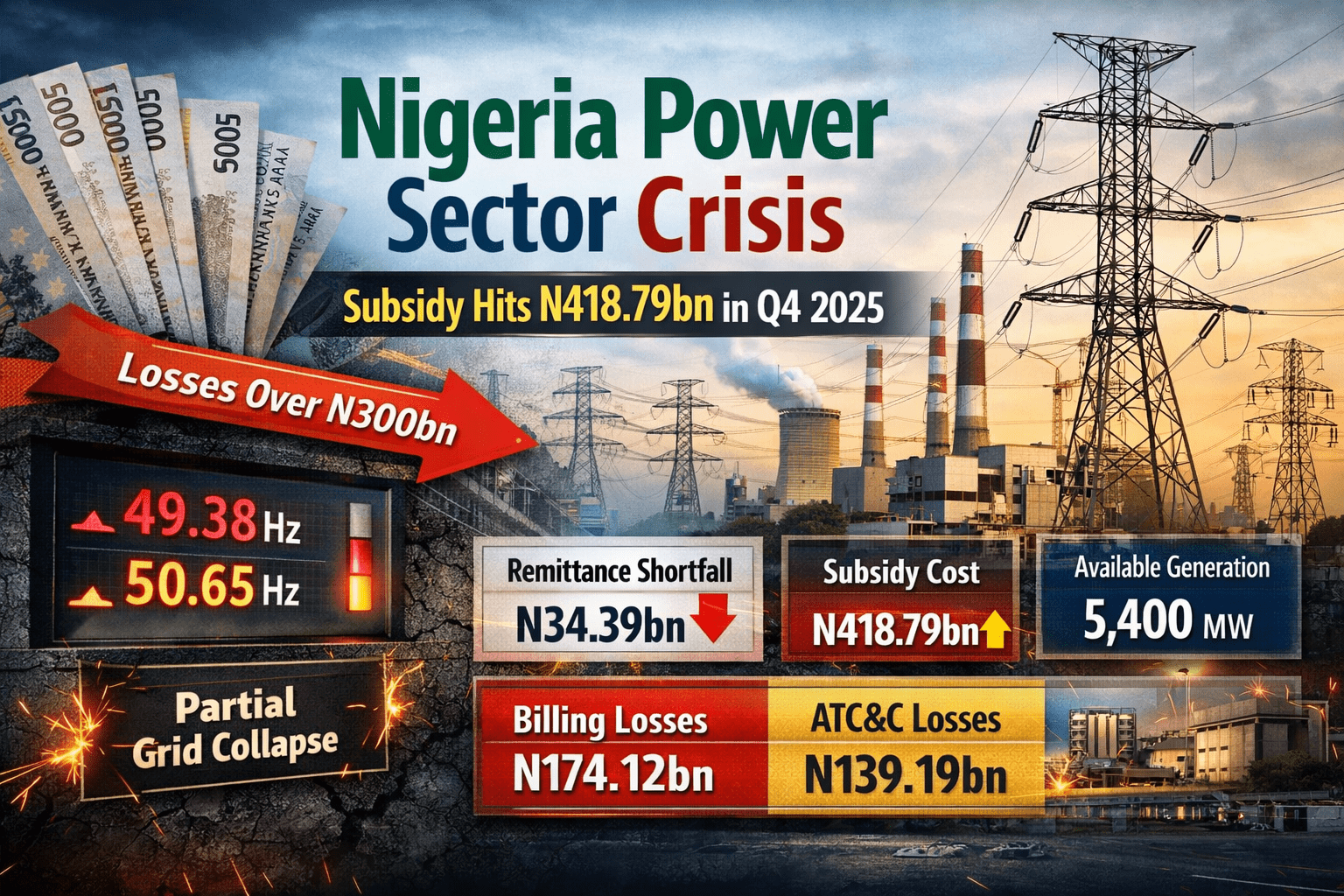
In Q4 2025, Nigeria’s electricity sector recorded major financial strain, as the Federal Government of Nigeria absorbed N418.79bn subsidy, according to a report by the Nigerian Electricity Regulatory Commission, covering nationwide power generation, distribution inefficiencies, and grid instability across the country due to non-cost-reflective tariffs and technical losses.
Subsidy Burden Rises Amid Cost Gaps
The report showed that generation companies issued invoices of N804.93bn in the quarter.
However, the government covered 52.30% of total generation costs.
This subsidy obligation stood at N418.79bn.
It reflected persistent pricing gaps in the electricity market.
In addition, increased allocation to Band A customers rose from 40% to 45%.
This shift slightly reduced subsidy pressure.
Revenue Losses Exceed N300bn
Total inefficiency-driven losses crossed N300bn in Q4 2025.
Billing losses reached N174.12bn across distribution companies.
Aggregate Technical, Commercial, and Collection (ATC&C) losses added N139.19bn more.
Combined, these inefficiencies significantly weakened sector revenue performance.
They also reduced financial stability across the value chain.
Billing Efficiency Declines Further
Distribution companies received 7,991.22GWh of electricity.
However, they billed only 6,614.57GWh to customers.
Billing efficiency stood at 82.03%.
This marked a slight decline from the previous quarter.
Remittance performance also weakened to 92.71%.
It dropped from 95.21% in Q3 2025.
DisCos paid N437.27bn out of N471.66bn required remittance.
This left a shortfall of N34.39bn.
Generation Improves Despite Constraints
Available generation capacity averaged 5,400.38MW.
This reflected a slight drop from the previous quarter.
However, energy generation improved overall.
Average hourly generation rose to 4,452.71MWh/h.
Total generation reached 9,831.58GWh.
Seventeen power plants recorded reduced output.
Despite gains, system instability persisted.
Frequency levels fell outside safe operational limits.
Average frequency ranged between 49.38Hz and 50.65Hz.
Both values remained outside normal grid standards.
Grid Instability and System Disturbance
The sector recorded one grid disturbance in Q4 2025.
A partial system collapse occurred on December 29.
Voltage fluctuations also remained frequent.
These issues continued to threaten grid reliability.
Structural Challenges Persist
The report highlighted deep structural weaknesses in the sector.
Non-cost-reflective tariffs remained a major constraint.
The commission warned that subsidy exposure remains open-ended.
This creates uncertainty for government finances.
Overall inefficiencies continue to undermine sector sustainability.
Despite reforms, challenges remain widespread across the value chain.