




 By
By Elizabeth Ugbo
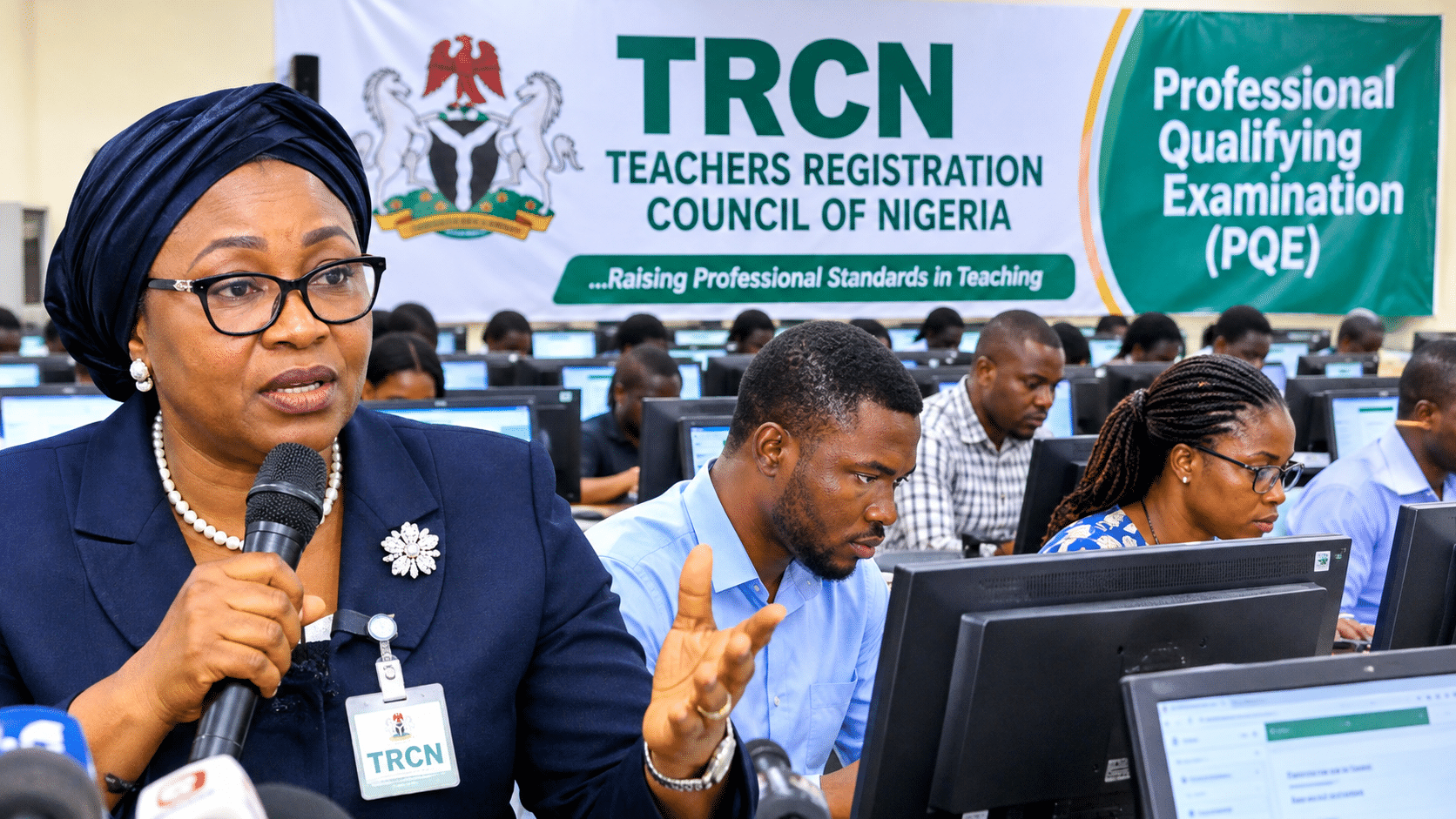
The Teachers Registration Council of Nigeria (TRCN) has uncovered 250 fake teaching certificates during a recruitment exercise in an unidentified state. The discovery occurred during a recruitment process involving about 1,000 teachers. Consequently, the council has introduced QR-coded certificates and stricter digital verification to eliminate unqualified teachers. TRCN Chief Executive and Registrar, Dr Ronke Soyombo, announced the development in Abuja on Thursday.
TRCN Moves Against Fake Teaching Certificates
Soyombo disclosed the discovery while monitoring the ongoing computer-based Professional Qualifying Examination (PQE). The examination took place at Redeemer’s TEAP International School, Abuja.
She explained that the council discovered the fake certificates during a state government recruitment exercise.
According to her, the unidentified state planned to recruit approximately 1,000 teachers.
Soyombo said the council introduced stronger verification measures to prevent unqualified individuals from entering Nigerian classrooms.
She warned that forged academic and professional credentials threatened the country’s education standards.
Council Introduces QR-Coded Certificates
To tackle certificate fraud, TRCN now issues certificates embedded with Quick Response (QR) codes.
The codes allow employers to verify credentials directly through the council’s official portal.
Consequently, recruitment officers can authenticate certificates before offering teaching appointments.
Soyombo said the measure would help eliminate fraudulent practitioners and protect Nigerian schoolchildren.
She also disclosed that TRCN had strengthened examination security through digital reforms.
TRCN Tightens Professional Qualifying Examination
The council now uses randomised questions based on candidates’ qualifications.
This approach prevents candidates with different academic qualifications from sharing identical examination questions.
For instance, PhD holders, first-degree graduates and NCE holders receive qualification-specific questions.
According to Soyombo, the system reduces opportunities for examination malpractice.
She urged candidates to avoid cheating and fraudulent shortcuts.
Furthermore, she assured Nigerians that TRCN would sustain its digital reforms to improve teaching standards.
FG Sets Deadline for Mandatory Teacher Certification
Soyombo disclosed that the Federal Government had established strict deadlines for teacher certification.
The government expects 75 per cent of teachers to obtain professional licences by December 2026.
Additionally, every teacher must secure certification before entering any classroom by December 2027.
She commended the Minister of Education, Dr Tunji Alausa, for supporting the mandatory certification programme.
Soyombo stressed that academic qualifications alone do not guarantee teaching competence.
She explained that teachers must demonstrate skills in pedagogy, child safeguarding and digital literacy.
TRCN Identifies Mathematics Weaknesses Among Teachers
The registrar also revealed weaknesses in mathematics among teachers during previous qualifying examinations.
Consequently, TRCN plans targeted training programmes with relevant education agencies.
The initiative aims to strengthen teachers’ subject knowledge and classroom effectiveness.
Soyombo said improving teachers’ professional competence remains essential to raising education standards nationwide.
Candidates Commend the Computer-Based Examination
Some candidates who spoke with the News Agency of Nigeria (NAN) praised the examination arrangements.
Ms Celestina Adejo said the questions improved her knowledge of child safeguarding and ICT security.
Meanwhile, Nigerian Navy education officer Ebi Mustapha said he took the examination to validate his professional competence.
Esther Ali, a teacher with 27 years of classroom experience, shared similar reasons.
Both candidates encouraged other teaching practitioners to obtain professional certification.
However, another candidate, Benjamin Edet, suggested improvements to the examination process.
He recommended that examination slips should display candidates’ assigned centres and schedules directly.
According to him, this would eliminate delays caused by WhatsApp groups and external links.
Abuja Examination Centre Strengthens ICT Infrastructure
The CBT Coordinator and ICT Administrator at Redeemer’s TEAP International School, Mrs Ann Ogbu, explained the centre’s preparations.
She said the facility deployed a 60kVA solar system to ensure uninterrupted power supply.
Additionally, the centre provided a 250kVA backup generator and 20 standby computers.
The school currently operates 220 computer systems and plans to expand to 320.
Ogbu said the centre successfully conducted demonstration tests with TRCN’s technical team.
These tests confirmed seamless server connectivity ahead of the examination.
She added that the school regularly hosts major examinations for several national institutions.
These include TRCN, the West African Examinations Council, the National Examinations Council and the Ministry of Foreign Affairs.
According to her, hosting these examinations demonstrates the school’s modern ICT facilities and commitment to quality education.
TRCN Records Increased Examination Registration
Soyombo also highlighted the impact of the council’s digital reforms on examination registration.
She said registration increased from 13,000 candidates in May 2025 to 26,000 in November 2025.
Meanwhile, approximately 21,000 candidates are currently taking the 2026 examination nationwide.
She added that candidates should receive their examination results digitally within one week.
The council believes these reforms will strengthen professional standards and improve accountability across Nigeria’s education sector.