



 By
By By Elizabeth Ugbo
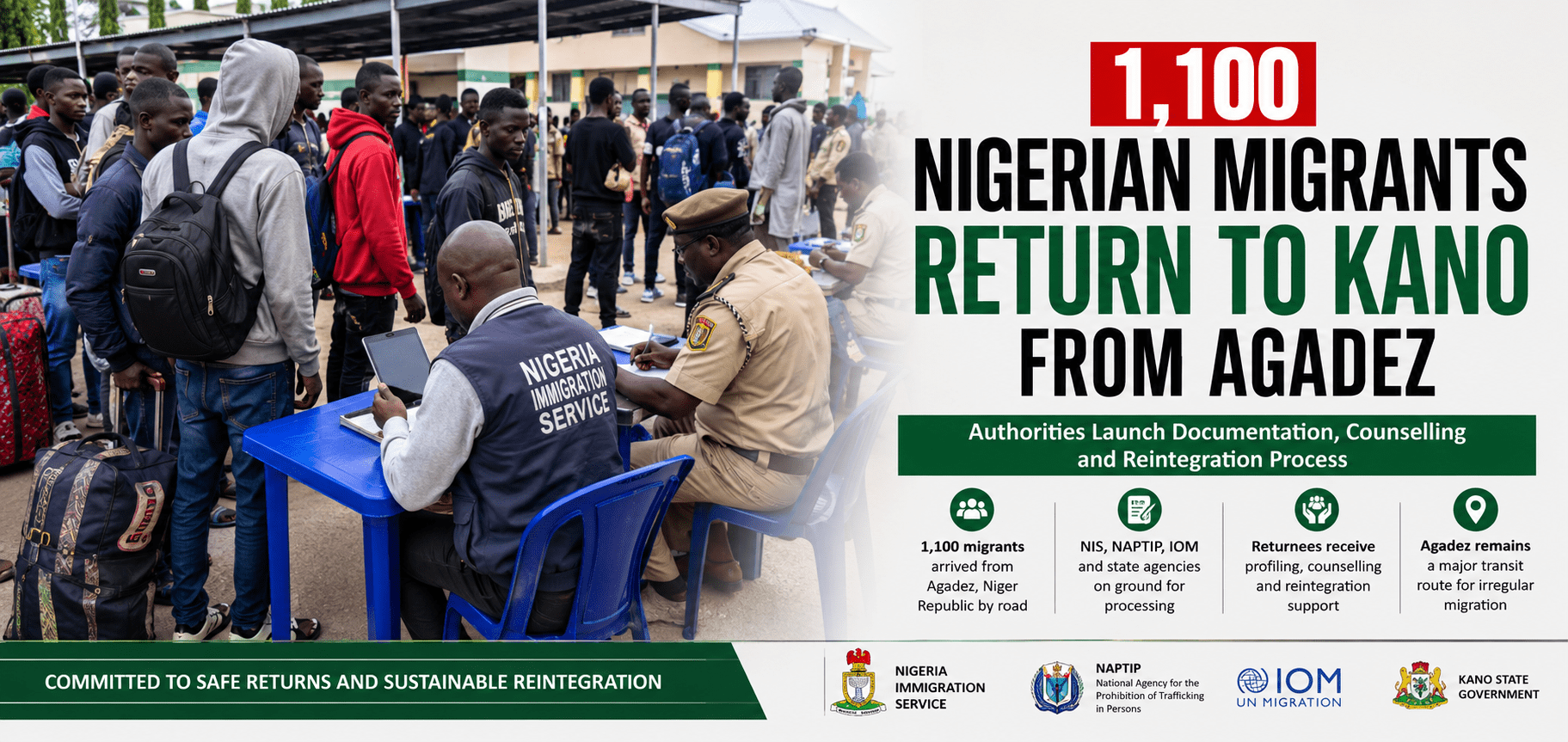
No fewer than 1,100 Nigerian migrants arrived in Kano State from Agadez in Niger Republic on Friday by road, as Nigerian authorities began documentation, counselling, and reintegration procedures. The returnees, mostly stranded migrants attempting irregular migration routes, were received at designated processing centres operated by federal and state agencies to support their safe return and reunification with families.
Authorities Begin Documentation and Reintegration
The Nigeria Immigration Service confirmed that officials from multiple government agencies coordinated the reception exercise to ensure orderly processing.
Commandant of the Immigration Training School, Kano, Anthony Akuneme, said personnel from the Kano Nationality Sortation Centre (KNSC), the Migrants Arrival, Knowledge and Information Area (MAKIA), and the International Transit and Stay of Knowledge (ITSK) centre managed the operation.
According to Akuneme, officials documented the returnees through the Migration Information and Data Analysis System before moving them to ITSK for final profiling, psychosocial counselling, and reintegration support.
He noted that the agencies worked together to guarantee safe and seamless processing.
How Kano Processes Returning Migrants
The Kano Nationality Sortation Centre, MAKIA, and ITSK serve as the official corridor for receiving and supporting returning migrants.
At these facilities, authorities:
- Register and profile returnees
- Provide psychosocial counselling
- Assess reintegration needs
- Connect migrants with family reunification services
- Coordinate follow-up support programmes
The reintegration framework operates jointly through the Nigeria Immigration Service, the National Agency for the Prohibition of Trafficking in Persons, the International Organization for Migration, and relevant state government agencies.
Agadez Remains a Major Migration Transit Route
Friday’s arrival reflects a recurring pattern of assisted and spontaneous returns from Agadez, a city in Niger Republic that has long served as a transit hub for West African migrants travelling toward Libya and Europe.
Between 2015 and 2018, Agadez became one of the busiest migration corridors globally, with hundreds of thousands of migrants moving through the route annually.
Later, Niger Republic introduced anti-smuggling laws under international pressure, reducing formal movement through the corridor.
However, irregular migration never completely stopped.
Migration Pressure Persists Across the Sahel
The International Organization for Migration stated that its operations in Niger Republic have supported voluntary humanitarian returns for thousands of stranded Nigerians since 2017.
Most returnees were reportedly young men from northern Nigeria who attempted to reach Europe but became stranded because of financial hardship, detention, or disruptions in smuggling networks.
The July 2023 military coup in Niger Republic, which removed President Mohamed Bazoum, reportedly weakened regional migration management systems after the withdrawal of French and United States forces.
Recent International Organization for Migration data also points to renewed movement along the Agadez corridor.
Meanwhile, the United Nations High Commissioner for Refugees reported in April 2026 that at least 269,010 Nigerians displaced by conflict in the North-East currently reside in the Diffa region of Niger Republic.