



 By
By By Elizabeth Ugbo
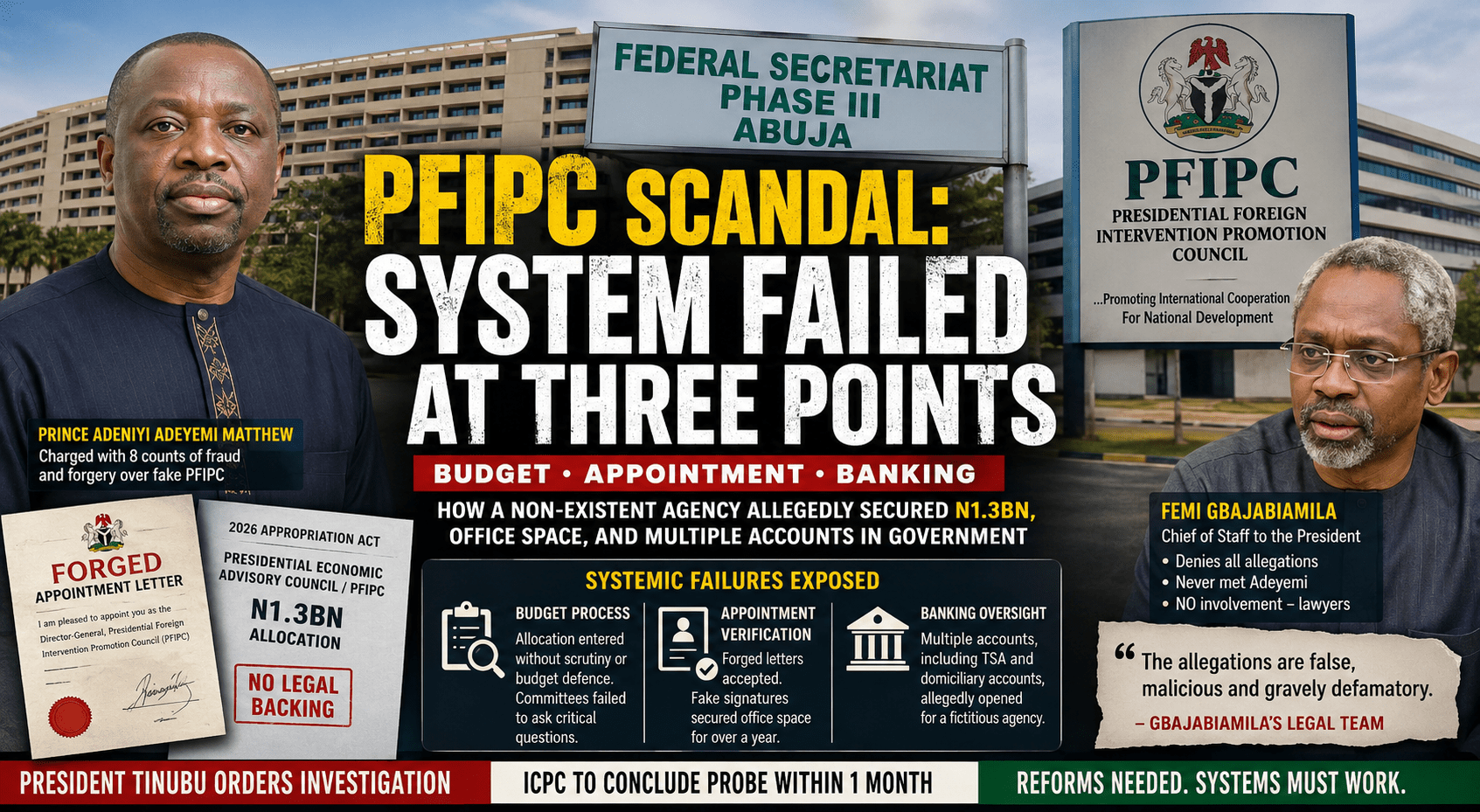
The alleged fraud involving the fake Presidential Foreign Intervention Promotion Council (PFIPC) has exposed serious weaknesses in Nigeria’s public administration. Authorities charged Prince Adeniyi Adeyemi Matthew with fraud and forgery after he allegedly used forged documents to establish the non-existent agency in Abuja, secure office space, and gain official recognition. The scandal, which surfaced in 2026, has prompted President Bola Tinubu to order a full investigation because it revealed major failures in budgeting, appointment verification, and financial oversight.
PFIPC Scandal Goes Beyond One Man
The PFIPC controversy extends far beyond the criminal charges against Adeyemi.
Although prosecutors filed eight counts of fraud and forgery against him, the bigger concern is how a non-existent government agency allegedly secured almost N1.3 billion in the 2026 Appropriation Act.
The fake council reportedly obtained office space inside the Federal Secretariat, installed official signage, hosted senior government officials from Nigeria and abroad, and allegedly operated several bank accounts.
These developments point to institutional failures rather than the actions of one individual alone.
Unless authorities strengthen government systems, similar incidents could happen again.
Budget Process Failed to Detect a Ghost Agency
One of the most troubling aspects of the scandal involves Nigeria’s budget process.
The 2026 Appropriation Act reportedly allocated N1.3 billion to the “Presidential Economic Advisory Council/PFIPC.”
However, PFIPC had no legal backing and was never created by the Federal Government.
Sources within the National Assembly claimed the allocation entered the budget through unofficial channels without undergoing proper budget defence.
Meanwhile, Adeyemi told social media influencer VeryDarkMan that security agencies detained him for 23 days while the budget was under preparation.
According to him, he neither prepared nor defended any budget proposal.
His claim raises serious questions.
Who presented the budget?
Which committee approved the allocation?
Why did lawmakers fail to verify the agency’s legal status?
Nigeria’s budgeting process has faced criticism for years over alleged insertions and inflated allocations.
The PFIPC case now demonstrates the dangers of weak budget scrutiny.
No agency without legal existence should receive public funds.
Appointment Verification System Also Failed
Another major weakness emerged during the appointment process.
Investigators alleged that Adeyemi presented a forged appointment letter carrying the purported signature of the Chief of Staff to the President, Femi Gbajabiamila.
Gbajabiamila’s legal team denied any relationship with Adeyemi.
They insisted the Chief of Staff never met him and never signed any appointment letter.
Despite those facts, officials reportedly accepted the forged documents.
Consequently, Adeyemi allegedly occupied office space inside the Federal Secretariat for over one year.
Even this month, visitors reportedly found PFIPC signboards directing them to the supposed council’s office within the Ministry of Health section.
This development exposed glaring weaknesses in document verification across government institutions.
If forged presidential documents can pass official scrutiny, other agencies also remain vulnerable.
Banking Oversight Raises Serious Questions
The financial aspect of the scandal presents another disturbing concern.
Investigators alleged that Adeyemi opened several government-linked bank accounts, including one at the Central Bank of Nigeria.
He also reportedly operated 34 bank accounts linked to fictitious agencies.
Adeyemi questioned how a non-existent agency could obtain Treasury Single Account access alongside domiciliary accounts.
His question highlights a critical issue.
Financial institutions must perform Know Your Customer (KYC) checks before opening accounts.
Therefore, authorities must explain how these accounts allegedly passed verification processes.
Investigators have recovered several items and arrested suspects.
However, they have yet to identify officials who approved the banking arrangements.
Chief of Staff Denies Allegations
The controversy also drew the Chief of Staff into public debate.
Adeyemi alleged that Gbajabiamila demanded 48 percent of a proposed N27.4 billion take-off grant and received N400 million through proxies.
However, Gbajabiamila strongly denied the allegations.
His lawyers described the claims as false and defamatory.
They subsequently filed a N10 billion defamation lawsuit against Adeyemi.
Ironically, Adeyemi admitted during his interview that he never met the Chief of Staff.
Furthermore, presidential appointments do not originate from the Office of the Chief of Staff.
Presidential spokesman Bayo Onanuga explained that the Secretary to the Government of the Federation (SGF) processes presidential appointments.
The forged documents also reportedly included counterfeit presidential letterheads and forged signatures.
Chief of Staff’s Office Triggered the Investigation
Available information suggests the Office of the Chief of Staff first alerted authorities to the fake agency.
The Nigeria Investment Promotion Council reportedly raised concerns before Gbajabiamila’s office issued a public disclaimer.
Following that action, police arrested Adeyemi and later arraigned him in court.
President Bola Tinubu subsequently directed the Independent Corrupt Practices and Other Related Offences Commission (ICPC) to investigate the entire matter.
Importantly, the President ordered investigators to complete the probe within one month.
Reports also indicate that KPMG may assist if investigators uncover broader financial irregularities.
Meanwhile, the House of Representatives has launched its own investigation.
The Senate suspended its planned probe to allow the presidential investigation to proceed.
Due Process Must Prevail
The legal process must continue without political interference.
Every suspect deserves the constitutional presumption of innocence until a competent court reaches a verdict.
Even if investigators eventually clear the Chief of Staff, the scandal still exposes serious weaknesses in government administrative controls.
Forged signatures, fake letterheads, and fraudulent appointments should never succeed inside federal institutions.
Four Critical Reforms Nigeria Must Implement
The PFIPC scandal offers an opportunity to strengthen governance.
1. Strengthen Budget Integrity
Every budget allocation should identify the sponsoring ministry, legal authority, responsible officials, and staffing structure.
Any allocation involving an unregistered agency should automatically trigger an Auditor-General investigation.
2. Create a Digital Appointment Verification Portal
The SGF should manage a public verification portal for all federal appointments.
Every appointment letter should contain a unique verification code.
Government agencies should reject any appointment that lacks digital verification.
3. Audit Federal Secretariat Office Allocations
Authorities should conduct a forensic audit of offices, signboards, and space allocations within the Federal Secretariat.
Officials should revoke every allocation lacking proper SGF or Head of Service approval.
4. Hold Financial Institutions Accountable
The Central Bank of Nigeria and commercial banks should explain how PFIPC allegedly obtained government-linked accounts.
Banks should cross-check every government account application against BVN, CAC, and official government databases before approval.
Conclusion
Prince Adeniyi Adeyemi allegedly exploited weaknesses within Nigeria’s public institutions.
However, weak systems made the alleged fraud possible.
The PFIPC scandal should serve as a wake-up call for government reforms.
Arresting suspects remains necessary.
Nevertheless, lasting solutions require stronger budget controls, secure appointment verification, tighter administrative oversight, and stricter financial accountability.
Without comprehensive reforms, another fake agency could exploit the same loopholes in the future.