




 By
By By Elizabeth Ugbo
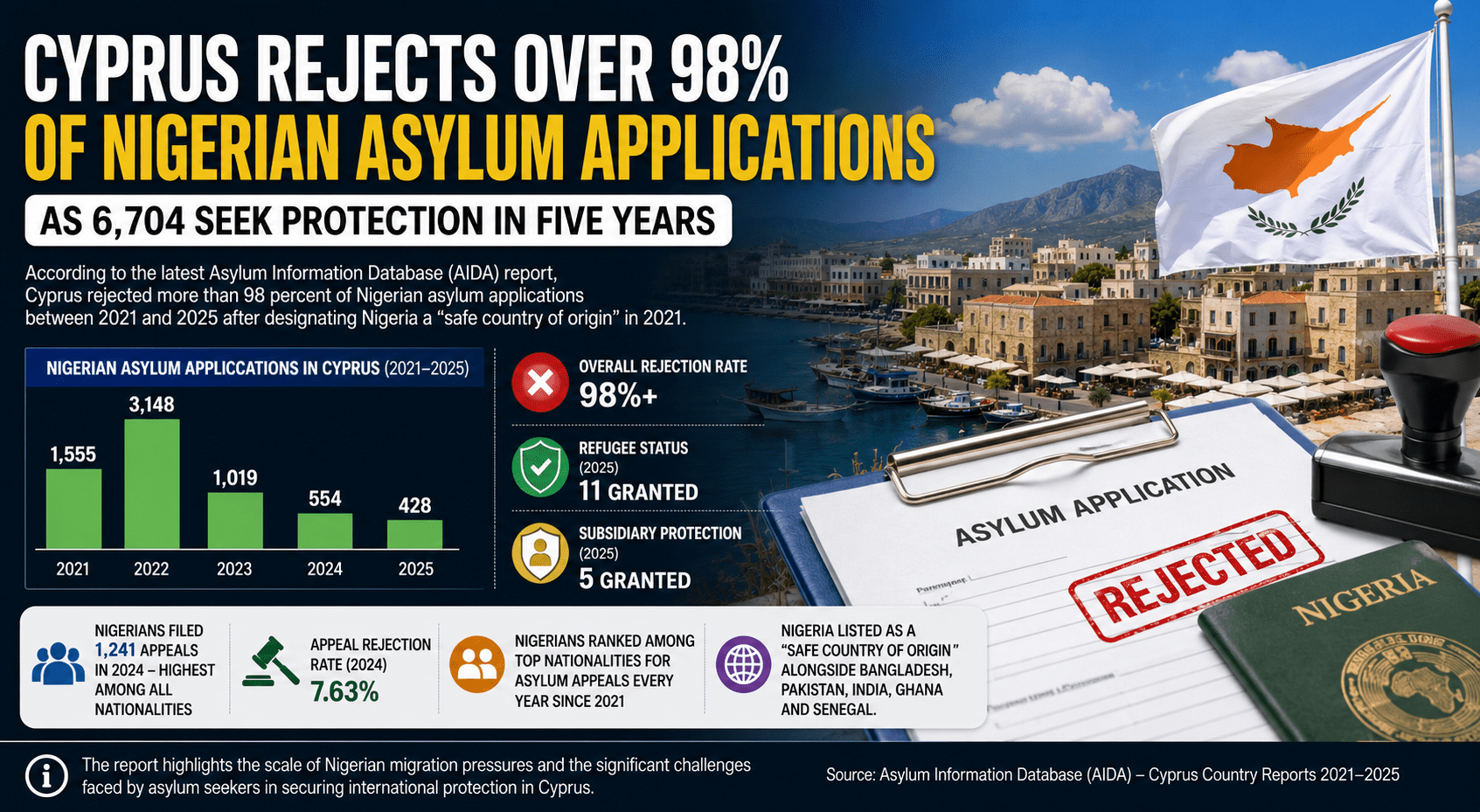
More than 6,704 Nigerians applied for asylum in Cyprus between 2021 and 2025, according to the latest Asylum Information Database (AIDA) report compiled from the Cyprus Asylum Service and the European Union Agency for Asylum. The report revealed that Cyprus rejected over 98 percent of Nigerian asylum applications during the period. The country maintained the high rejection rate after classifying Nigeria as a safe country of origin in 2021, leading to faster processing and stricter assessments.
Nigerian Asylum Applications Decline After 2022 Peak
The report showed that Nigerian asylum applications rose sharply from 1,555 in 2021 to 3,148 in 2022. However, applications dropped significantly afterward.
Nigeria recorded:
- 1,555 applications in 2021
- 3,148 applications in 2022
- 1,019 applications in 2023
- 554 applications in 2024
- 428 applications in 2025
Overall, asylum claims from Nigerians declined by about 70 percent between 2022 and 2025.
Refugee Recognition Remains Extremely Low
Despite thousands of applications, very few Nigerians secured international protection.
In 2021, only nine applicants received refugee status. None obtained subsidiary protection. Authorities rejected 498 applications, producing a 98.2 percent rejection rate.
In 2022, only 11 Nigerians gained refugee status. Again, no applicant received subsidiary protection. Authorities rejected 670 applications, maintaining a 98.4 percent rejection rate.
The trend continued in 2023. Cyprus processed 1,019 Nigerian applications and granted refugee status to only 43 people. Two applicants received subsidiary protection. Meanwhile, pending cases increased to 2,816.
Applications and Approvals Fell Further in 2024 and 2025
In 2024, new Nigerian applications dropped to 554. Authorities combined them with 288 pending cases.
Out of 995 decisions, only 77 applicants received refugee status.
In 2025, Cyprus handled decisions affecting 565 Nigerian applicants. Officials processed 270 cases on their merits.
The report classified 546 decisions as overall rejections. This figure included inadmissible claims, withdrawals and closed files. Only 254 cases qualified as strict merit-based rejections.
Furthermore, authorities granted refugee status to only 11 Nigerians, while five applicants received subsidiary protection.
Consequently, the overall protection rate stood at 0.16 percent, while the in-merit protection rate reached only 0.36 percent.
Nigeria Listed as a Safe Country of Origin
Cyprus designated Nigeria a safe country of origin in 2021.
The list also includes:
- Bangladesh
- Pakistan
- India
- Ghana
- Senegal
As a result, Nigerian applicants face accelerated asylum procedures, shorter deadlines and a legal presumption that their claims lack merit.
Nigerians Lead Asylum Appeals
Many Nigerians challenged initial asylum decisions.
According to the report, Nigerians ranked among the top nationalities filing appeals before Cyprus’s International Protection Administrative Court.
In 2024, Nigerians submitted 1,241 appeals, the highest number among all nationalities. However, authorities rejected 7.63 percent of appeal cases, while no applicant secured refugee recognition at the appeal stage.
In 2025, Nigerians filed 411 appeals, ranking second behind applicants from the Democratic Republic of the Congo, who submitted 1,394 appeals.
The report also identified the top five nationalities filing appeals in 2023 as:
- Nigeria
- Bangladesh
- Pakistan
- Democratic Republic of the Congo
- Nepal
Syria No Longer Tops Asylum Applications
Syria remained the leading source of asylum applications for several years.
However, that changed in 2025, when many Syrians reportedly stayed home following the fall of the Assad regime.
Meanwhile, applicants from the Democratic Republic of the Congo, Cameroon, Pakistan, Bangladesh and India continued to feature prominently among asylum seekers in Cyprus.
Why Nigerians Seek Protection
The report noted that Cyprus hosts a growing Nigerian community.
Most Nigerians study at private universities. Others work legally, live with family members or seek asylum after their student or work permits expire.
Some applicants also enter Cyprus through irregular routes from the Turkish-controlled northern part of the island.
Refugee Status Requires Strong Evidence
Under European Union and Cypriot asylum laws, applicants must prove a well-founded fear of persecution based on:
- Race
- Religion
- Nationality
- Political opinion
- Membership of a particular social group
Applicants who fail to meet these conditions may qualify for subsidiary protection if they face torture, the death penalty or serious harm caused by armed conflict.
Report Highlights Ongoing Challenges
The findings underscore the difficulties Nigerians face when seeking international protection in Cyprus.
Although thousands applied over five years, the country’s safe-country policy and strict asylum procedures resulted in consistently high rejection rates and very low refugee recognition.