



 By
By By Elizabeth Ugbo
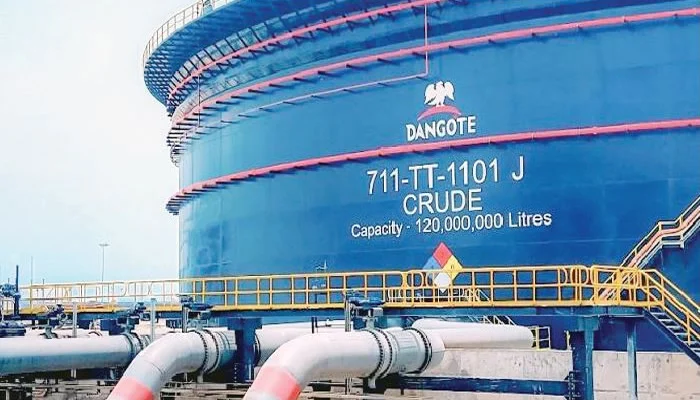
The Dangote Petroleum Refinery has resumed selling Premium Motor Spirit (PMS) in naira after importers allegedly withheld fuel stocks to trigger higher prices. A senior refinery official disclosed this on Sunday, explaining that the decision was taken in Nigeria to prevent fuel scarcity, stabilize petrol prices, and protect consumers while discussions with the Federal Government on crude supply continue.
Dangote Explains Return to Naira Petrol Sales
A senior management official, who requested anonymity because he was not authorised to speak publicly, said the refinery’s decision was driven by national interest.
According to the official, the move had nothing to do with resolving the refinery’s crude oil supply challenges.
Instead, the refinery noticed that some importers allegedly withheld petrol supplies while anticipating another increase in market prices.
“We took a decision in the interest of the country to start selling Premium Motor Spirit in naira because importers were holding back their goods, expecting a price increase,” the official said.
Refinery Ends Brief Dollar Pricing Regime
The Dangote refinery recently ended its short-lived dollar-denominated petrol sales.
In a notice issued by its commercial department, the refinery announced a gantry price of ₦1,215 per litre and a coastal price of ₦1,602,495 per metric tonne.
The decision reversed an earlier policy that required marketers to purchase petrol in United States dollars.
That policy unsettled the downstream petroleum sector and prompted the Federal Government to intervene.
Independent Marketers Opposed Dollar Sales
Independent petroleum marketers suspended product loading after the refinery introduced dollar payments.
They argued that sourcing foreign exchange for fuel purchases was difficult and expensive.
Earlier, the refinery explained that it adopted dollar pricing because it no longer received sufficient crude oil under the Federal Government’s naira-for-crude arrangement.
As a result, it sourced additional crude from the international market using dollars.
Talks With Federal Government Continue
The management official confirmed that discussions with the Federal Government remain ongoing.
He expressed optimism that both parties would reach an agreement that supports local refining.
“I hope the government will act in good faith once an agreement is reached,” the official added.
He also criticised the continued export of crude oil while refined petroleum products are imported into Nigeria.
According to him, some government interests still favour crude exports instead of supporting domestic refining.
Dangote Refinery Changes Nigeria’s Fuel Market
Before the Dangote refinery began operations in 2024, Nigeria depended heavily on imported petrol despite being one of Africa’s leading crude oil producers.
The Port Harcourt, Warri and Kaduna refineries remained largely non-functional for years.
Consequently, fuel importers dominated the market, while Nigerians faced recurring fuel shortages and subsidy-related challenges.
However, the commencement of operations at the Dangote refinery transformed the downstream petroleum sector.
The Nigerian National Petroleum Company Limited also ended implicit fuel subsidy payments, reducing the long fuel queues previously experienced nationwide.
Petrol Prices Fall After Dangote’s Announcement
Last week, some depot owners raised petrol gantry prices to as high as ₦1,275 per litre after the refinery temporarily suspended loading.
However, following Dangote’s announcement of a ₦1,215 per litre gantry price, many depots reduced their prices to remain competitive.
According to Petroleumprice.ng, depot prices currently range between ₦1,215 and ₦1,220 per litre.
Similarly, retail pump prices now vary between ₦1,260 and ₦1,300 per litre, depending on location.
Global Oil Prices Still Pose Risks
Meanwhile, renewed tensions in the Middle East continue to influence global crude oil prices.
Oil prices climbed above $100 per barrel last Thursday before closing at about $96 per barrel on Friday.
The increase followed escalating attacks on commercial shipping in the Red Sea, raising fears of prolonged supply disruptions.
Higher crude prices could increase Nigeria’s export earnings and government revenue.
However, they may also raise the cost of imported refined products, fuel inflation and increase petrol prices if local supply becomes inadequate.