




 By
By By Elizabeth Ugbo
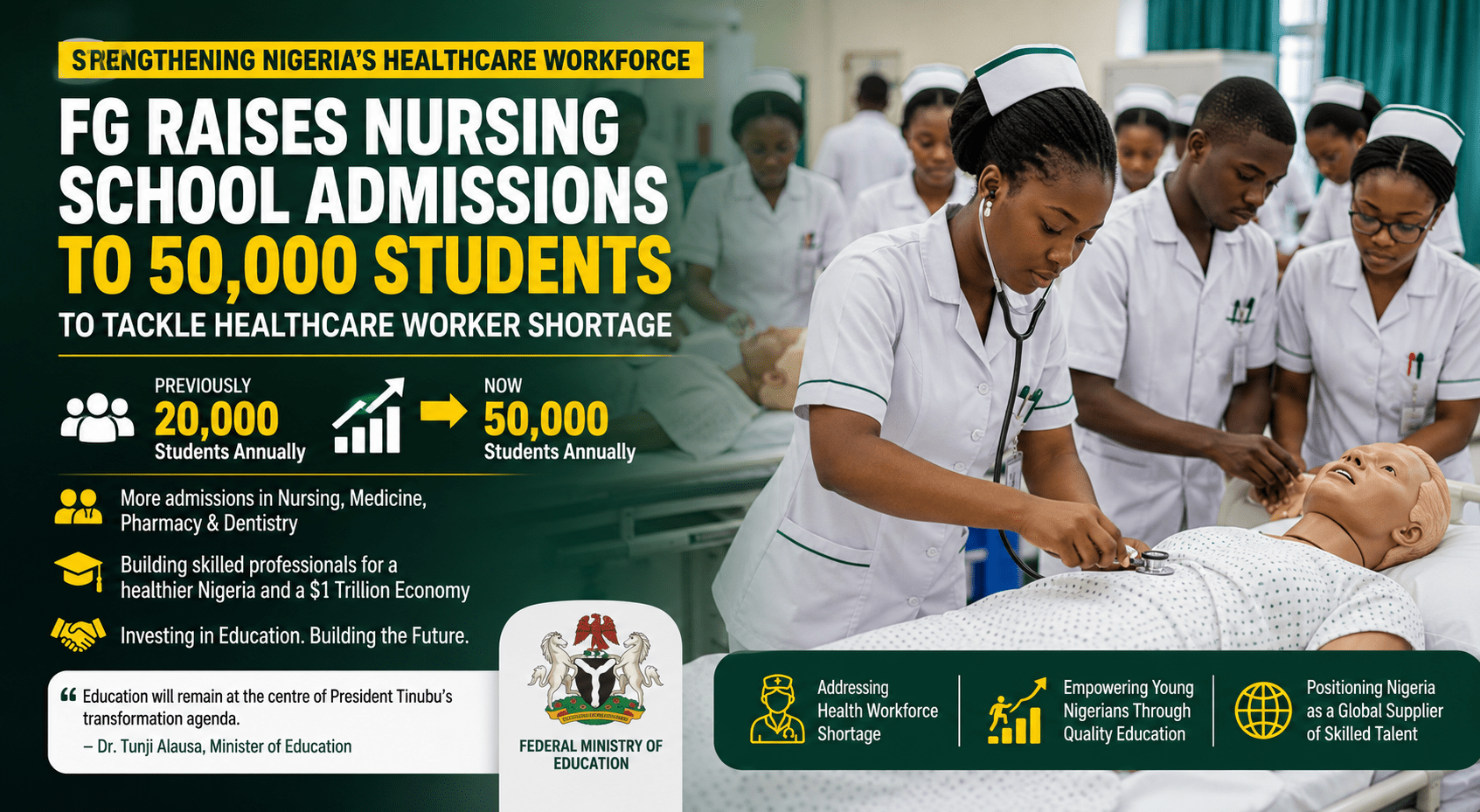
The Federal Government has increased annual admissions into nursing schools from 20,000 to 50,000 students across Nigeria, Minister of Education Dr. Tunji Alausa announced on Sunday during an interview with journalists. The move aims to address the country’s shortage of healthcare professionals, strengthen the health workforce, and support President Bola Tinubu’s vision of building a $1 trillion economy by 2030 through investment in education and human capital development.
Government Expands Health Education to Bridge Workforce Gap
Alausa said the increase in nursing admissions forms part of broader education reforms designed to produce skilled professionals for critical sectors.
According to him, the government is investing heavily in human capital development by expanding access to professional education.
“We want to be the manpower supplier of the world. We need to produce competent, skilled and educated young Nigerians who will drive our economy, contribute to Africa’s growth and compete successfully across the world,” he said.
The minister added that admissions into medicine, pharmacy, and dentistry have also increased significantly.
He expressed confidence that the reforms would reduce the shortage of healthcare professionals within the next few years as thousands of graduates enter the workforce.
Tinubu’s Economic Vision Drives Education Reforms
Alausa said education remains central to President Tinubu’s economic agenda.
“As the President advances his vision of building a one trillion-dollar economy, education will remain at the centre of that transformation,” he said.
He explained that the administration views education as the foundation for sustainable economic growth and national development.
NELFUND Designed for Long-Term Sustainability
The minister reaffirmed that the Nigerian Education Loan Fund (NELFUND) was structured to remain viable beyond the current administration.
“There is no value in introducing policies that cannot stand the test of time. Sustainability is central to this administration’s philosophy, and that principle guided the design of NELFUND,” Alausa stated.
He stressed that the government prioritised long-term policies capable of supporting future generations.
Industrial Peace Returns to Tertiary Institutions
Alausa also said the administration restored industrial harmony in tertiary institutions through sustained dialogue with academic and non-academic staff unions.
He noted that improved stability has enhanced teaching, learning, and overall performance across higher institutions.
Government Responds to Nigeria’s Healthcare Worker Shortage
Nigeria has struggled with a shortage of nurses and other healthcare professionals for several years.
The challenge stems from limited training capacity and the migration of skilled workers to countries offering better salaries and working conditions.
Consequently, many hospitals, especially at the primary and secondary healthcare levels, have experienced staffing gaps.
To address the problem, the Federal Government expanded admissions into nursing and other health-related programmes while increasing investments in Technical and Vocational Education and Training (TVET).
The expansion also responds to the growing “Japa” trend, which has seen thousands of Nigerian-trained doctors and nurses relocate abroad.
Government officials believe increasing training capacity will meet domestic healthcare demands while positioning Nigeria as a global supplier of skilled healthcare professionals.