




 By
By By Elizabeth Ugbo
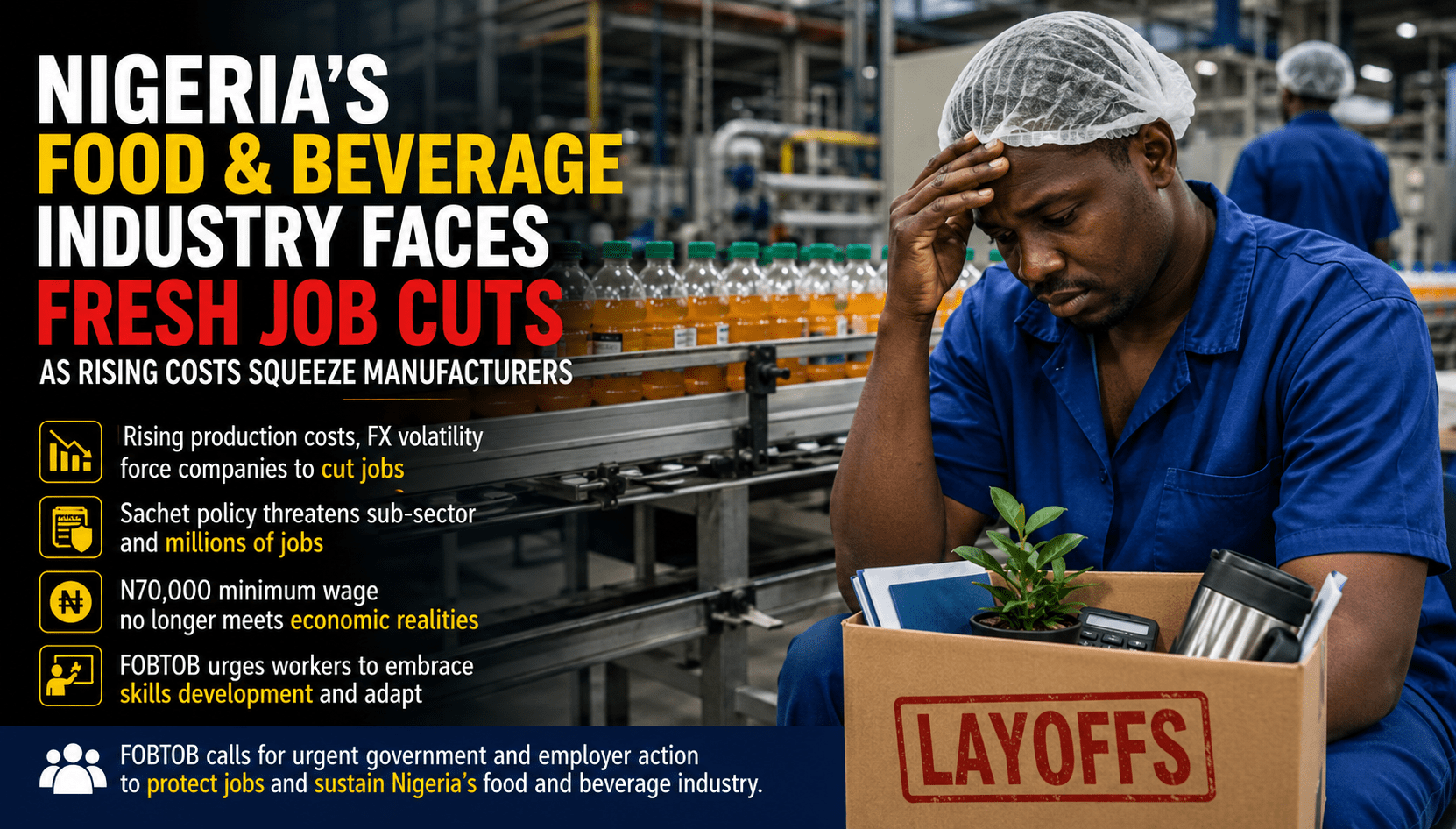
Nigeria’s food and beverage industry is witnessing rising job losses as manufacturers battle soaring production costs, foreign exchange volatility, poor infrastructure and restrictive government policies. The warning came from the Food, Beverage and Tobacco Senior Staff Association (FOBTOB) during the 114th Session of the International Labour Conference in Geneva. FOBTOB President, Oyibo Jimoh, said the crisis has forced many companies to reduce their workforce to survive. He urged the government to introduce urgent interventions to protect jobs and keep businesses afloat.
Exchange Rate Crisis Driving Job Losses
Jimoh explained that many food and beverage manufacturers rely heavily on imported raw materials. Consequently, the unstable foreign exchange market has sharply increased production costs.
“Most of our companies depend on imported raw materials. The exchange rate challenge is biting harder, and that is understandable,” he said.
According to him, the worsening forex situation has compelled several companies to restructure operations and reduce staff strength to remain in business.
Sachet Product Restrictions Threaten More Jobs
Jimoh also criticised restrictions on sachet products and beverages packaged below 200 millilitres. He said the policy has already resulted in job losses across the sector.
“As I am talking to you, many of our members have been thrown into the labour market. We are still engaging the government to find a lasting solution,” he stated.
He argued that smaller package sizes remain the preferred option for many Nigerians because inflation has weakened purchasing power.
“Not everybody wants to buy large pack sizes. Smaller packs are the cash cow. Allowing that policy to continue could shut down that sub-sector,” he warned.
Manufacturers Face Multiple Operational Challenges
The FOBTOB president noted that manufacturers are also struggling with poor road infrastructure, unstable electricity supply and weak consumer demand.
“The economy is very tough for every business. Whether it is roads, energy or purchasing power, companies, especially in the food sector, face enormous challenges,” he said.
He warned that without targeted government support, more businesses could close, leading to additional job losses.
Minimum Wage Remains Inadequate
Jimoh described the current national minimum wage of N70,000 as insufficient to meet workers’ basic needs.
“There is no amount that can truly quantify labour. However, in this economy, N70,000 cannot go anywhere,” he lamented.
He urged employers to improve workers’ salaries where possible while balancing wage increases with the economic realities confronting businesses.
Workers Should Upgrade Their Skills
Jimoh encouraged employees to embrace continuous learning and acquire new skills to remain competitive in today’s technology-driven workplace.
“Workers should upgrade themselves. When trends change, move with them and avoid becoming unemployable,” he advised.
He added that FOBTOB would continue organising zonal meetings and capacity-building programmes on career development, retirement planning and adapting to workplace changes.
FOBTOB Reaffirms Commitment to Workers
Jimoh reaffirmed FOBTOB’s commitment to protecting workers’ welfare while supporting policies that promote the long-term sustainability of Nigeria’s food and beverage industry.
He stressed that collaboration between government, employers and labour unions remains essential to preserving jobs and ensuring the industry’s continued growth.