




 By
By By Elizabeth Ugbo
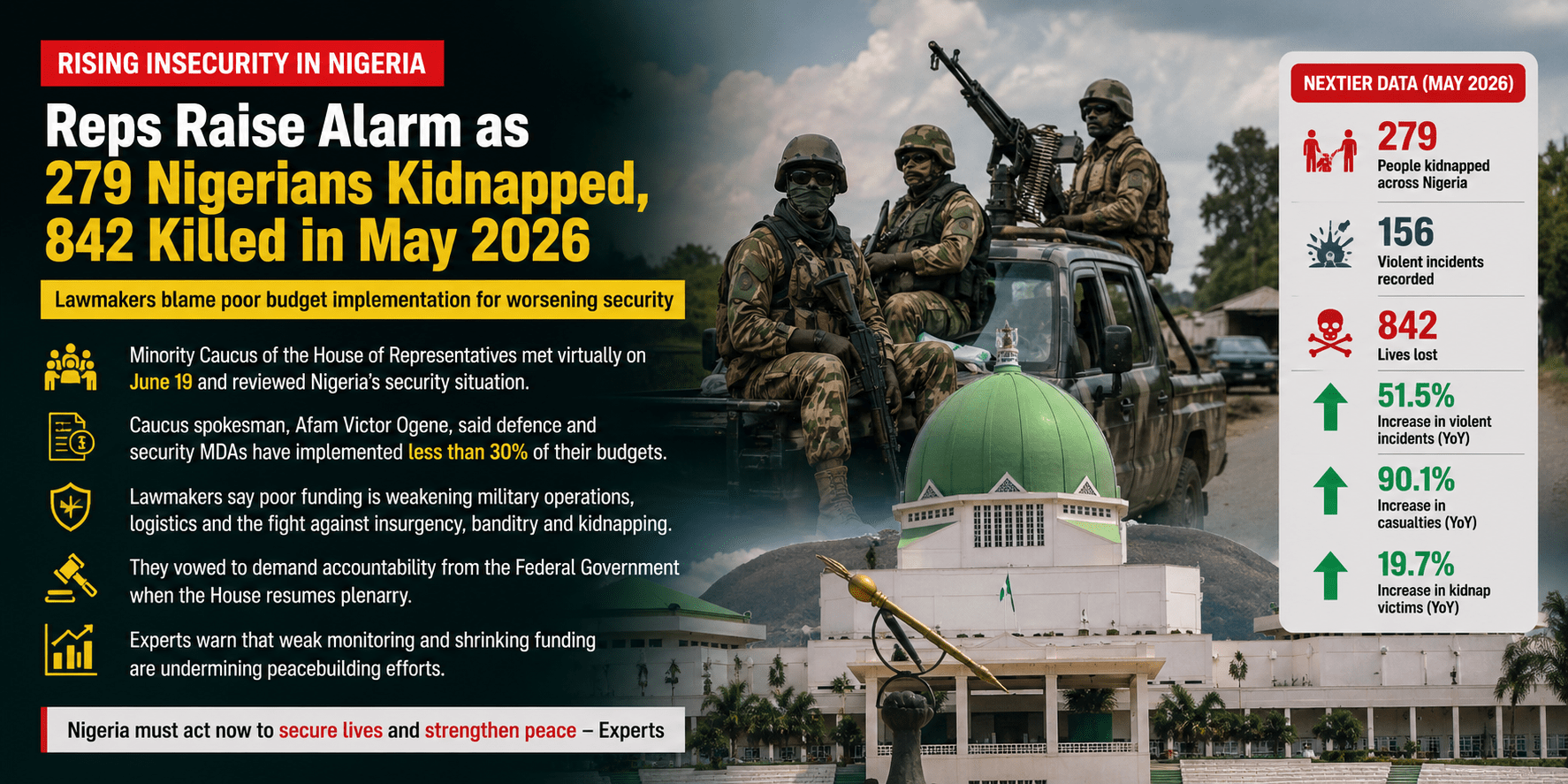
The Minority Caucus of the House of Representatives has blamed poor budget implementation for worsening insecurity in Nigeria after 279 people were kidnapped and 842 others killed in May 2026. The lawmakers, who met virtually on June 19, said defence and security agencies have implemented less than 30 per cent of their approved budgets. They vowed to demand answers from the Federal Government when the House resumes plenary, arguing that inadequate funding has weakened security operations across the country.
Minority Caucus Faults Budget Implementation
The position formed part of resolutions reached during the emergency virtual meeting, where lawmakers reviewed Nigeria’s security situation and assessed the implementation of major government programmes.
Briefing journalists after the meeting, the caucus spokesman, Afam Victor Ogene, said key defence and security Ministries, Departments and Agencies (MDAs) have implemented less than 30 per cent of their budgets.
“Available records indicate that budget implementation in key defence and security agencies remains below 30 per cent. That is unacceptable given the scale of insecurity confronting the nation,” Ogene said.
The lawmakers argued that poor funding has weakened military operations, logistics and the fight against insurgency, banditry, kidnapping and other violent crimes.
They also accused the executive of repeatedly failing to implement budgets approved by the National Assembly since 2024.
According to the caucus, budget oversight remains one of the legislature’s constitutional responsibilities. Therefore, the Federal Government must account for the poor implementation of approved appropriations.
The lawmakers confirmed they would formally raise the issue when plenary resumes.
Nextier Report Shows Rising Violence
The lawmakers’ concerns followed the release of fresh security data from Nextier’s Nigeria Violent Conflicts Database.
The report revealed that 279 people were kidnapped across Nigeria in May 2026. It also recorded 156 violent incidents that claimed 842 lives during the month.
Compared with May 2025, violent incidents increased by 51.5 per cent, casualties rose by 90.1 per cent, while kidnap victims increased by 19.7 per cent.
The figures have intensified concerns over the country’s deteriorating security situation despite increased investments in security and peacebuilding programmes.
Experts Question Peacebuilding Impact
Development practitioner Jamilu Musa and Political Science lecturer Dr. Chukwuma Okoli said weak impact assessment frameworks continue to undermine peacebuilding efforts.
In their policy article titled The Travails of Measuring Peacebuilding in Fragile Contexts, the researchers argued that governments and development partners invest significant resources in peacebuilding. However, measuring the actual impact of those interventions remains difficult.
They noted that shrinking international funding makes effective monitoring and evaluation even more important.
According to the experts, stakeholders should move beyond counting activities and instead measure whether interventions make communities safer, more inclusive and more resilient against emerging security threats.
Criminology Society Urges Tinubu to Act
Meanwhile, the President of the Nigeria Society for Criminology (NSC), Professor Oludayo Tade, urged President Bola Tinubu to intensify efforts to protect Nigerians from rising security threats.
He stressed that stronger security strategies and effective implementation of approved budgets remain critical to reversing the country’s worsening security challenges.