




 By
By By Elizabeth Ugbo
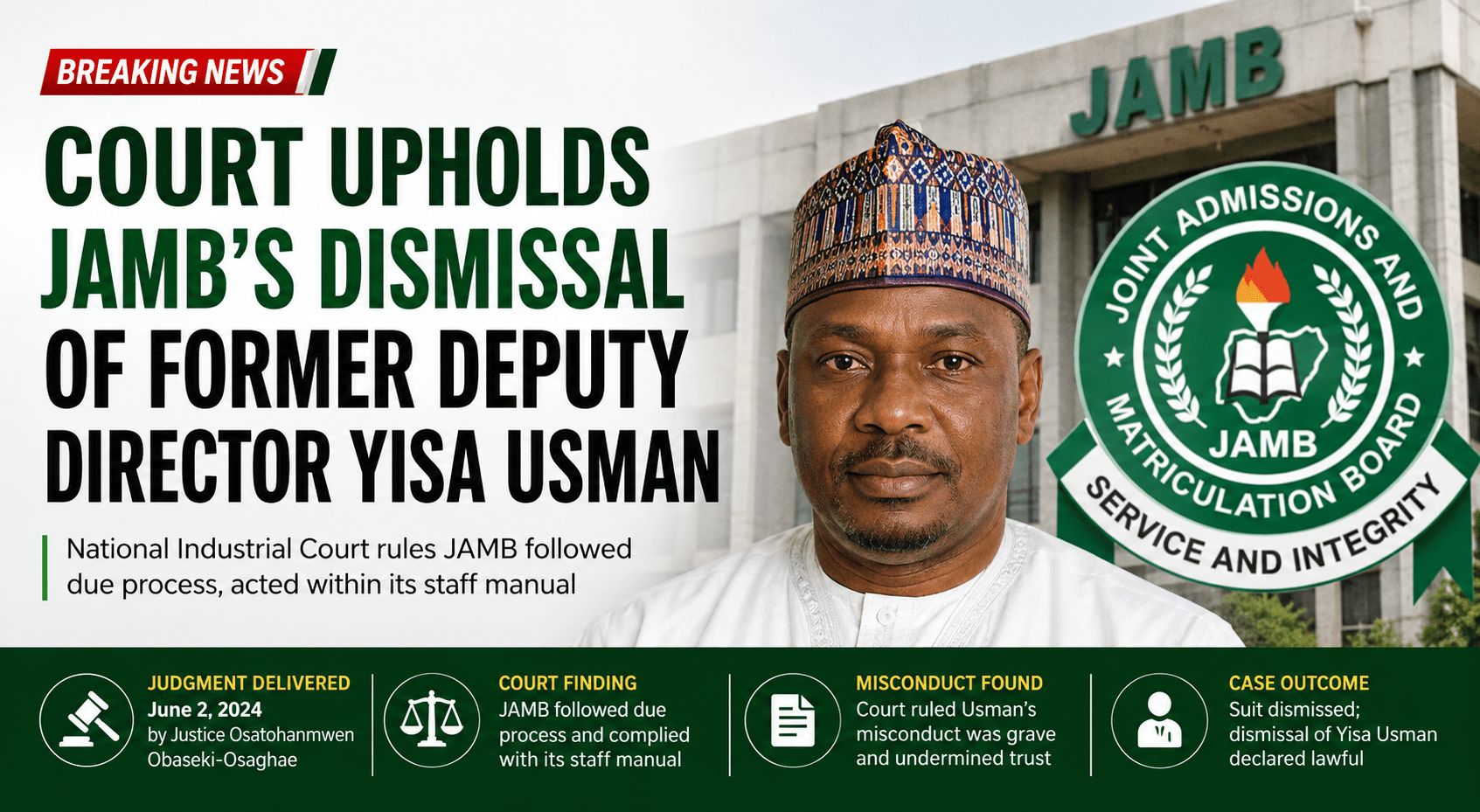
The National Industrial Court in Abuja has upheld the dismissal of former Joint Admissions and Matriculation Board (JAMB) Deputy Director, Yisa Usman, ruling that the examination body lawfully terminated his appointment. Justice Osatohanmwen Obaseki-Osaghae delivered the judgment on June 2, stating that JAMB followed due process and complied with its staff manual when it dismissed Usman in July 2023 over allegations of misconduct.
Court Affirms JAMB Followed Due Process
Justice Obaseki-Osaghae ruled that JAMB complied with its disciplinary procedures before dismissing Usman. The court found that the disciplinary committee operated within the provisions of the board’s staff manual.
The judge also held that the committee’s composition complied with the federal character principle. Additionally, the Minister of Education approved the committee before it began its work.
Furthermore, the court noted that the JAMB Registrar and Director of Finance recused themselves from the committee because Usman had mentioned them in his petitions.
Court Rejects Fair Hearing Claims
The court dismissed Usman’s claim that JAMB denied him a fair hearing.
According to the judgment, JAMB issued queries to Usman, which he answered. The board also invited him to appear before the disciplinary committee. However, Justice Obaseki-Osaghae ruled that Usman voluntarily chose not to attend the committee’s proceedings.
The judge concluded that JAMB provided him with adequate opportunities to defend himself.
Misconduct, Not Whistleblowing, Led to Dismissal
Justice Obaseki-Osaghae ruled that Usman’s dismissal had no connection with his whistleblowing activities.
The court observed that Usman admitted during proceedings that anti-corruption agencies investigated his allegations against JAMB’s management and cleared the board of wrongdoing.
The judge described Usman’s misconduct as grave and serious.
“From the totality of the evidence adduced, I find that the misconduct of the claimant is grave and weighty. He wilfully disobeyed constituted authority.”
The judge added that his actions undermined the confidence JAMB had reposed in him.
She further stated that Usman behaved as though he was accountable only to himself rather than his employer.
Court Dismisses Victimisation Allegations
Usman argued that JAMB victimised him after he submitted whistleblowing petitions alleging corruption and misconduct within the examination body.
He also claimed that members of the disciplinary committee had conflicts of interest because they were subjects of his petitions.
Consequently, he approached the National Industrial Court in September 2023, seeking reinstatement with full salaries, benefits and other entitlements. He also asked the court to declare his dismissal unlawful and unconstitutional.
However, the court rejected those claims.
JAMB Defends Its Decision
JAMB argued that several government and security agencies investigated Usman’s allegations and cleared its management of any wrongdoing.
The board maintained that Usman was not a whistleblower. Instead, it described him as “a self-serving individual whose stock in trade is blackmail.”
JAMB further explained that Usman’s queries resulted from petitions he and his associates submitted to the Federal Ministry of Education.
Following an investigation, the ministry’s committee reportedly cleared the management and recommended disciplinary action against him.
The Minister of Education later approved the disciplinary committee’s report, leading to Usman’s dismissal in July 2023.
Court Declares Dismissal Lawful
Justice Obaseki-Osaghae concluded that JAMB fully justified its decision to dismiss Usman.
She ruled that the examination body complied with its staff manual and followed the required disciplinary process.
The judgment effectively ends Usman’s legal challenge against his dismissal and affirms JAMB’s position that it acted lawfully throughout the disciplinary proceedings.