



 By
By By Elizabeth Ugbo
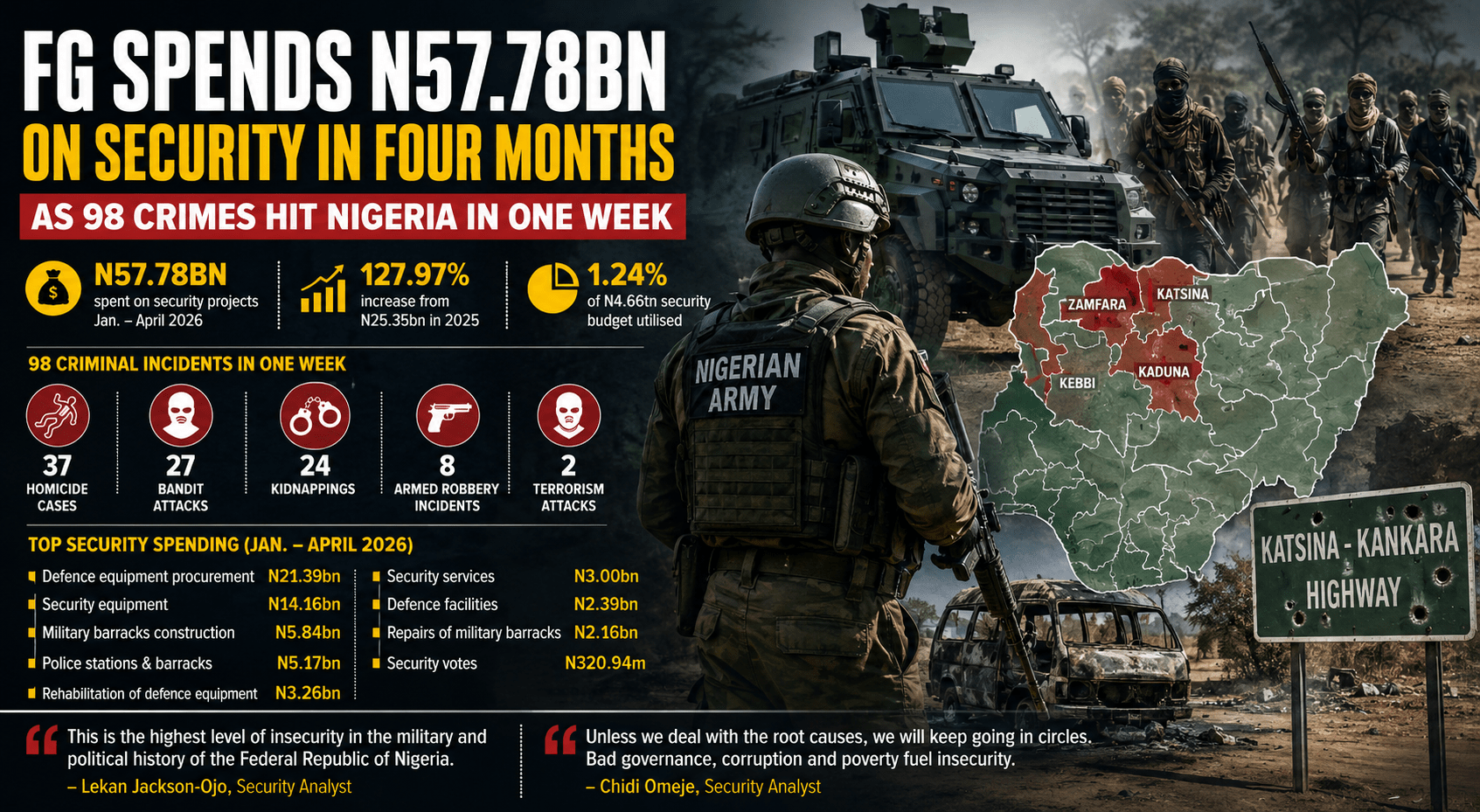
The Federal Government spent N57.78 billion on security projects and operations between January and April 2026, yet violent attacks continued across Nigeria. Data from the Open Treasury Portal showed that only 1.24 per cent of the N4.66 trillion security budget had been utilised. Within the same week, police recorded 98 criminal incidents across several states, including kidnappings, bandit attacks and homicides, raising fresh concerns over the effectiveness of government spending on security.
Security Spending Rises by 128%
Figures from the Open Treasury Portal revealed that security spending reached N57.78 billion in the first four months of 2026. The amount represents a 127.97 per cent increase from the N25.35 billion spent during the same period in 2025.
The government allocated N4.66 trillion to security in the 2026 budget. However, only 1.24 per cent of the allocation had been released by April.
Defence Equipment Receives Largest Allocation
The largest share of the spending went to defence equipment procurement.
The government spent:
- N21.39bn on defence equipment procurement
- N14.16bn on security equipment
- N5.84bn on military barracks construction
- N5.17bn on police stations and barracks
- N3.26bn on rehabilitation of defence equipment
- N3bn on security services
- N2.39bn on defence facilities
- N2.16bn on repairs of military barracks
- N320.94m as security votes
Despite the increased spending, many critical security projects recorded very low implementation rates.
Key Military Programmes Receive No Funding
Several important defence programmes received no funding during the review period.
No money was released for the military operations budget line known as Operation Lafiya Dole and Other Operations of the Armed Forces, despite a N500 million allocation.
Likewise, the government made no release for the kitting of Armed Forces personnel, although the budget provided N2.53 billion for the programme.
Police Report 98 Criminal Incidents in One Week
A police security report obtained by The PUNCH showed that Nigeria recorded 98 criminal incidents within seven days.
The report listed:
- 37 homicide cases
- 27 bandit attacks
- 24 kidnappings
- Eight armed robbery incidents
- Two terrorism-related attacks
The incidents occurred across Kaduna, Katsina, Zamfara, Kebbi and several other states.
Many attacks involved mass abductions, assaults on rural communities and kidnappings along major highways.
Zamfara and Katsina Record Major Attacks
Among the most disturbing incidents, bandits abducted 39 residents in Zamfara State after they reportedly entered the Fadama Forest to negotiate peace with notorious bandit leader Jimo Smally.
In Katsina State, bandits blocked the Katsina-Kankara highway and attacked a commercial vehicle carrying 11 passengers.
Police rescued nine victims. However, the driver and another passenger remained missing.
Experts Say Security Crisis Is Worsening
Security analyst Lekan Jackson-Ojo described the situation as Nigeria’s worst security crisis.
“This is the highest level of insecurity in the military and political history of the Federal Republic of Nigeria.”
He said Nigeria had suffered unprecedented military losses.
According to him, the country lost nearly four generals within three months without any visible reprisal operations.
He also warned that insecurity continues to damage economic growth.
“It is an indirect pronouncement that Nigeria is an unsafe territory now. No economy thrives under insecurity.”
Military Faces Heavy Operational Burden
Another security analyst, Chidi Omeje, said the military remained overstretched despite higher government spending.
He explained that troops currently operate in more than 30 conflict zones across the country.
Omeje also noted the enormous cost of military hardware and operations.
According to him, the available funds become insignificant after converting them into foreign currency for defence procurement.
Analysts Blame Governance Failures
Omeje argued that military action alone cannot solve Nigeria’s security challenges.
He said poor governance, corruption and widespread poverty continue to fuel insecurity.
“Unless we deal with the root causes, we will keep going in circles.”
He also blamed porous borders and instability across the Sahel region.
According to him, terrorists easily move from Mali and Burkina Faso into Nigeria because of weak border management.
Reintegration Policy Faces Criticism
Omeje criticised the government’s policy of reintegrating repentant terrorists.
He argued that countries fighting terrorism rarely return convicted terrorists to society.
According to him, the policy reflects weak political will and poor leadership.
Political Leaders Urged to Prioritise Security
The analyst also faulted Nigeria’s political elite for focusing on election campaigns instead of addressing insecurity.
“What preoccupies our political class is campaign, campaign, campaign. This is a sad situation.”
He urged the Federal Government to develop practical solutions rather than relying solely on military operations.
According to him, security agencies require stronger political support, better governance and improved border management to address the crisis effectively.