




 By
By By Elizabeth Ugbo
The National Bureau of Statistics (National Bureau of Statistics) released its 2023 Demographic Bulletin in Abuja, Nigeria, in 2023. It reported 3,381,228 internally displaced persons across 14 states. The bulletin aimed to support policy planning and national development. It used data from surveys and administrative records. The report highlighted displacement trends, population data, health indicators, and migration flows across the country.
Nigeria IDP Statistics for 2023
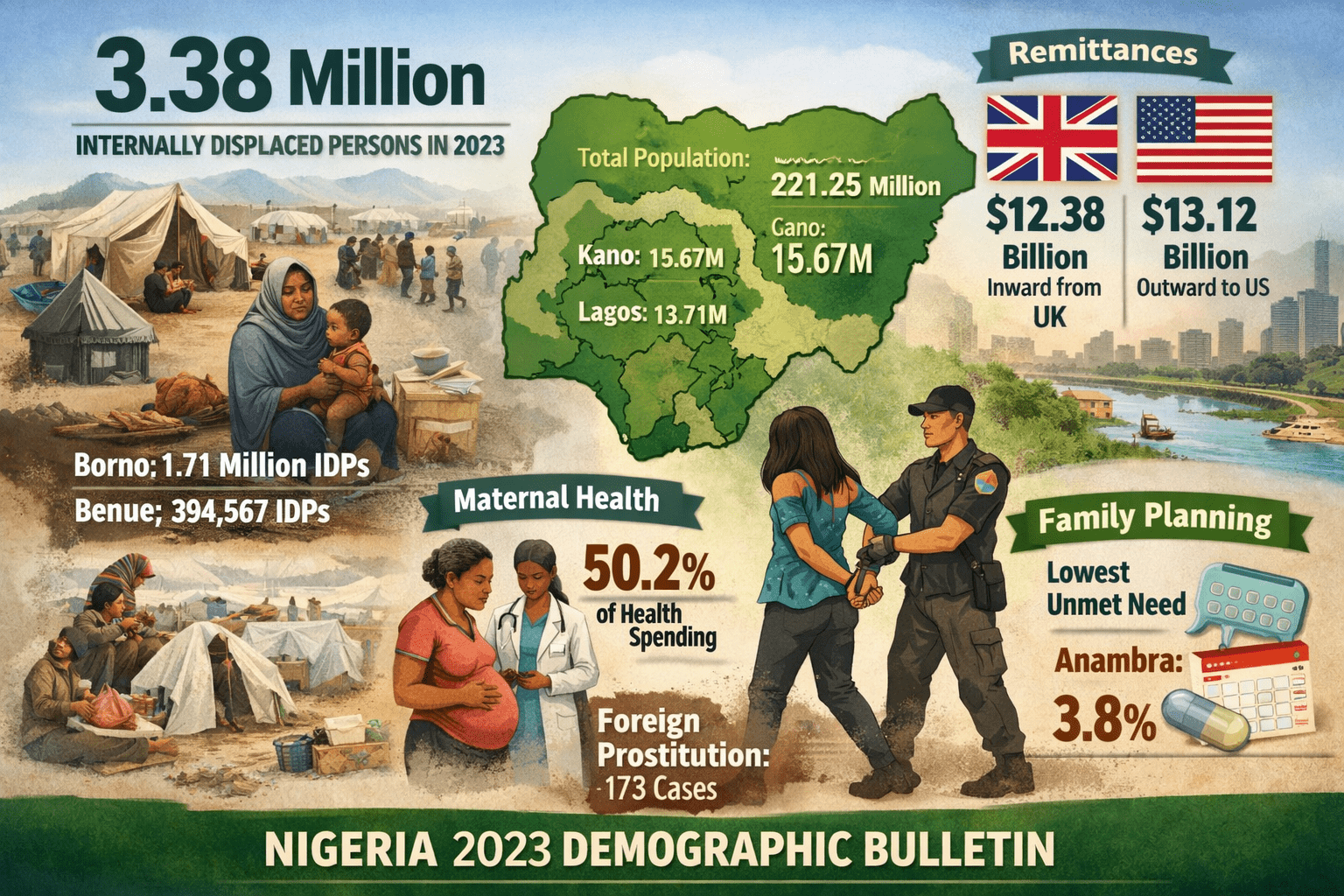
Nigeria recorded 3.38 million internally displaced persons in 2023. The figures covered 14 states nationwide. The report showed rising humanitarian pressure in affected regions. In addition, displacement data revealed uneven distribution across states.
Borno State accounted for the highest displacement figures. It recorded 1,711,481 IDPs, representing 50.62 percent of the total. Benue followed with 394,567 displaced persons. Katsina recorded 244,380 IDPs.
At the lower end, Gombe, Nasarawa, and Kano recorded fewer cases. Their figures stood at 52,383, 20,580, and 15,549 respectively.
Borno, Benue Dominate Displacement Figures
Borno remained the epicenter of displacement in Nigeria. Conflict and insecurity drove large-scale population movement. Benue also recorded significant displacement due to violence and instability.
Overall, the data showed that a few states carry most of the national burden. This trend highlights the need for targeted humanitarian response.
Nigeria Population Reaches 221 Million
The bulletin estimated Nigeria’s population at 221,250,127 in 2023. The figures came from projections by the National Population Commission. Males accounted for 112,434,239 people. Females accounted for 108,815,888.
Kano remained the most populous state with 15.67 million people. Lagos followed with 13.71 million residents. Katsina ranked third with 10.66 million people.
Meanwhile, Nasarawa and Bayelsa recorded the lowest populations. They stood at 2.95 million and 2.58 million respectively.
Maternal Health Spending and Care Trends
The report showed that maternal health dominated healthcare spending in 2022. It accounted for 50.22 percent of capital expenditure. It also represented 52.46 percent of recurrent spending.
The bulletin further showed improvements in antenatal care. Skilled antenatal care rose from 50 percent in 2011 to 67 percent in 2018. However, it declined slightly to 63 percent in 2021.
Despite progress, gaps in maternal healthcare still exist. Policymakers continue to focus on improving access nationwide.
Remittance Flows: UK and US Lead Transfers
The bulletin highlighted international remittance patterns using data from the Central Bank of Nigeria. The United Kingdom remained the largest source of inward remittances in 2023. It contributed 12.38 billion dollars.
This figure dropped slightly from 12.76 billion dollars in 2022. Meanwhile, the United States recorded the highest outward remittance flow. It stood at 13.12 million dollars in 2022.
These trends reflect strong diaspora financial engagement. They also show shifts in global economic flows.
Human Trafficking Cases Rise in 2023
Nigeria recorded 968 human trafficking cases in 2023. The cases included both domestic and international incidents. Foreign travel linked to prostitution accounted for 173 cases.
This category remained the highest reported trafficking trend. The data highlights ongoing challenges in law enforcement. It also signals the need for stronger cross-border coordination.
Family Planning and Health Access
The report revealed improvements in reproductive health services. Anambra State recorded the lowest unmet need for birth spacing at 3.8 percent. This indicates better access to family planning services.
Other states showed higher unmet needs. The findings suggest uneven access to reproductive healthcare across Nigeria. Policymakers continue to address these gaps.
Conclusion
The 2023 Demographic Bulletin provides critical national insights. It covers displacement, population growth, health, and migration trends. The data supports evidence-based planning and policy decisions.
Nigeria continues to face major humanitarian and demographic challenges. However, the report also shows progress in key development areas.