



 By
By By Elizabeth Ugbo
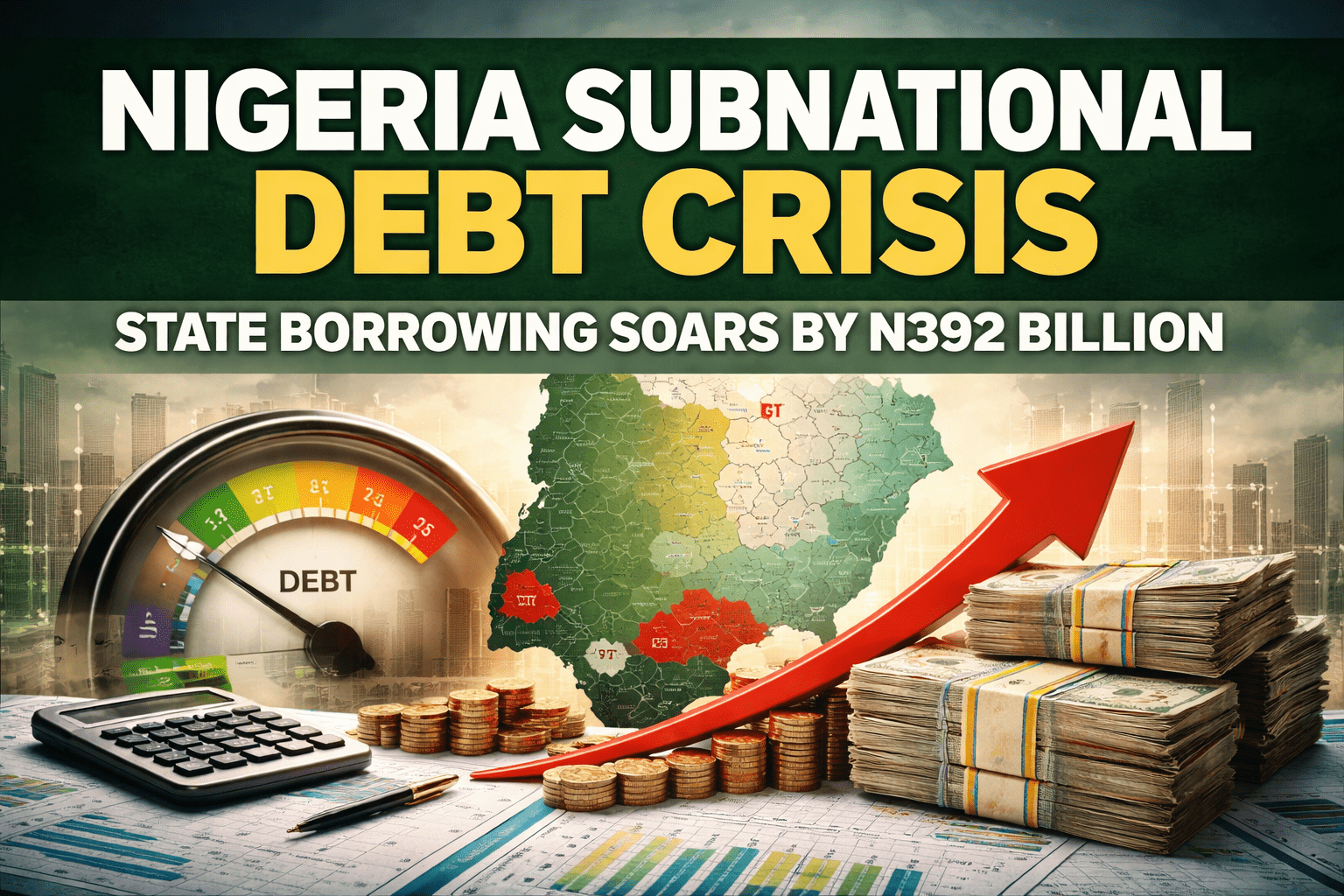
Nigeria’s subnational debt crisis intensified in 2025 as state governments increased borrowing despite economic pressures. Data from the Debt Management Office shows that, Nigeria’s 36 states and the Federal Capital Territory, expanded domestic debt by N392.41 billion, between December 2024 and December 2025,across Nigeria, to finance deficits and infrastructure gaps, and through sustained domestic borrowing.
Rising Subnational Debt in Nigeria
Total domestic debt rose from N3.97 trillion in 2024 to N4.36 trillion in 2025. This represents a 9.89% increase.
Although borrowing increased overall, the trend remains uneven. Notably, 22 states reduced their debt. However, 14 states and the FCT expanded their debt portfolios. As a result, total debt continued to climb.
States That Reduced Their Debt
Several states improved their fiscal positions during the period. For example, Imo reduced debt by N42.40 billion. Akwa Ibom followed with N37.35 billion. Bayelsa also cut N31.34 billion.
In addition, Plateau, Gombe, and Edo recorded strong reductions. Abia, Anambra, and Benue also lowered their debt levels. Meanwhile, states like Adamawa, Kogi, and Oyo posted moderate declines.
Furthermore, Katsina, Ekiti, Sokoto, and Kano reduced their debt steadily. Smaller reductions came from Ebonyi, Ondo, Osun, and Zamfara. Kebbi and Nasarawa recorded minimal decreases.
States Driving the Debt Surge
Despite these gains, several states drove the overall increase. Lagos recorded the largest rise, adding N319.27 billion.
The FCT followed with N125.31 billion. Kaduna added N58.88 billion, while Delta recorded N49.26 billion. Similarly, Yobe and Enugu posted increases above N38 billion.
Other contributors include Cross River, Ogun, and Borno. Rivers, Bauchi, and Taraba also expanded their debt. Meanwhile, Kwara, Niger, and Jigawa recorded smaller increases.
Percentage Growth Highlights
Debt growth appears sharper in percentage terms. Kaduna’s debt surged by 228.53%. The FCT followed with 197.15%.
Yobe recorded a 92.60% increase. Borno grew by 52.75%, while Lagos rose by 35.47%. Enugu also posted a 32.12% increase.
Nigeria’s Broader Debt Context
The subnational trend reflects national debt pressures. Nigeria’s total public debt reached N159 trillion in 2025.
Domestic debt accounted for N84.84 trillion, while external debt stood at N74.42 trillion. Earlier figures showed subnational debt at N4.002 trillion by September 2025.
Notably, subnational debt represents a small share of total public debt. However, its rapid growth raises sustainability concerns.
Top 10 Most Indebted States
Debt remains concentrated among a few states. Ten states account for 67% of total subnational debt.
Lagos leads with N1.045 trillion, about 26% of the total. Rivers follows with N381.205 billion. Delta ranks third with N247.171 billion.
Enugu, Ogun, and Bauchi also feature prominently. Niger, Cross River, and Benue maintain high debt levels. Akwa Ibom completes the top ten.
Key Drivers of State Borrowing
States continue to borrow due to persistent budget deficits. Infrastructure gaps also drive spending needs.
In addition, declining oil revenues limit federal allocations. As a result, states rely more on domestic borrowing.
However, experts warn that poor fiscal discipline worsens the situation. Weak revenue generation also limits sustainability.
Expert Criticism and Fiscal Concerns
Financial analyst Mathew Gambo criticised rising debt levels. He described the trend as fiscal irresponsibility.
According to him, many states receive adequate federal allocations. Therefore, rising debt raises concerns about transparency and accountability.
He highlighted Kwara, Niger, and Jigawa as examples. These states show limited infrastructure despite increased borrowing.
Furthermore, he warned that borrowing without visible assets creates long-term risks. This pattern could push states into fiscal distress.
Impact on Development Spending
Rising debt increases servicing costs. Consequently, states spend less on health and education.
High interest rates and currency depreciation worsen the burden. As a result, development projects suffer.
Moreover, excessive borrowing crowds out capital investment. This weakens long-term economic growth.
The Way Forward
Experts recommend stronger fiscal discipline. States must improve internally generated revenue (IGR).
In addition, authorities should enforce stricter borrowing limits. Transparency and accountability must also improve.
Ultimately, sustainable borrowing requires linking debt to development outcomes. Without reform, fiscal risks will continue to rise.